My getting to live in the Costa del Sol and griping about what was largely a high-rise resort town peopled by all the other foreigners who'd found it first made me laugh. It also reminded me of an immortal quip from one of my favorite philosophers, Pogo, who said:
We have met the enemy and he is us.
Today's Thought
And so we make our home in Torre Blanca (between the cities of Malaga and Marbella). The much larger city of Malaga is about a 20 minute car ride away and is a pretty and culturally interesting Andalucian city on the sea, with trees and parks and considerable wealth to fund new as well as old museums. The city, like some of its citizens, seems to be getting a face-lift. When we arrived, the upcoming big event was Semana Santa (which we had to miss). It occurs in many Spanish cities and rather resplendently in Malaga, I’m told. Life-sized and often ancient painted, bejeweled and gilded statues of Jesus and Mary, among other sacred symbols, are carried through the streets in a religiously costumed procession, with local notables (like Antonio Banderas) bearing some of the honoured weight in the procession.
Torre Blanca itself is tiny and undistinguishable from the next little resort town of Los Boliches, which leads to another resort area, and so on, dotting the shore of Fuengirola. We live in a hi-rise penthouse right beside the Mediterranean at a low relatively low rent because a lovely friend of ours owns it. Besides, we're great renters who like to care for the places we live in. It's a surprising change from the cozy quarters we had in France. It’s spacious and gorgeously private. Views of the sea (across the street) are shown from our 360 terrace-patio. The view of our surroundings is spectacular and unobstructed. I hope you can see some suggestion of this from of the photos I took from our terrace.


The paved and well-tended boardwalk continues for more kilometers than I can walk, past many local vendors claiming and renting their territory as an umbrella-covered beach. Of course the beach is free to anyone, but a lounge and umbrella cost 4.50 Euros. No one is using them when we arrive and mostly they remain covered under tarps. But as the season progresses they come out, as do the tourists sitting in them, even though the sea still remains empty but for some surfers attracted by the wind and waves.

The weather is quite variable from mid December (when we arrived) to mid March. There are flowers outside even in December. But I fear for them. We have dramatic thunderstorms with Zeus-like bolts of lightening and winds whipping up the waves and salt. The rain comes down in sheets: a cold monsoon.Then for a few days it's like springtime again. People we'd seen wearing rain-parkas are now out in shirtsleeves. By mid March it is reliably a very mellow and warm springtime. And by the end of March, the beaches are filling with lots of white people lying in the sun to get browner.

As the season grows milder we share it with more and more skateboarders, lineskaters, bicycle riders, and carriage-pushers. I belong to the many cane-holders who form a notable part of the pedestrian contingent. It's no wonder there are so many of us in similar shape.The boardwalk, which I walk on nearly every day that we're not visiting elsewhere, is really a treat. The pleasure of walking on this well-tended promenade has been a great incentive for me and made it easy for me to do. It encourages walking for anyone who loves the sound of the sea and fresh air. This is a fine place for making it relatively easy for folks with some impairment to get out and enjoy.
Along with many benches along the promenade, there are many fresh-fish restaurants to stop at for the grilled fish prepared on contained wood fires outdoors. The food is simple and good: a great variety of very fresh fish. I’ve eaten more fish than ever in my life, and enjoyed it. I've written about the excellent fish and fresh produce in another post (The Gustatory Olympics). The vegetables were gorgeous, as well as delicious (the best red peppers!). So I put some out on the main room table to look at!

There are restaurants offering local fish and paella, of course. But there are at least as many offering "English breakfasts", "Scandanavian sandwiches" (or something like that, since I'm guessing at the Swedish), and similar fare to please the foreign guests. Many different British pubs cater to different areas of Britain, complete with televised sport matches and a guarantee of fellow Brits. Same for the Scandanavian or German specialty-pubs. They look inviting; but it remains a bit of a wonder to me why someone would travel to a different country in order to be with other foreigners from his or her own.
 |
fishing boat right across the street from our place
The little cafés in town behind the beach are quite nice to sit at and sip the strong brew here. We had our favorites, finding one, the Tahona, we expecially liked beside the church in Los Boliches... a distance that made a good exercise for me. Aside from its freshy prepared and very flavorfull sweet and savory baked goods, its owners were gentle folk who spoke only Spanish (with the usual smattering of English, if necessary).
|
It’s culturally rather vapid but pleasant in this spot, with many on borrowed time, including me. Still, it's a fine and comfortable place to hang out, get your International Herald Tribune right downstairs, and read it sitting on a bench beside the sea. Things couldn't be more convenient.
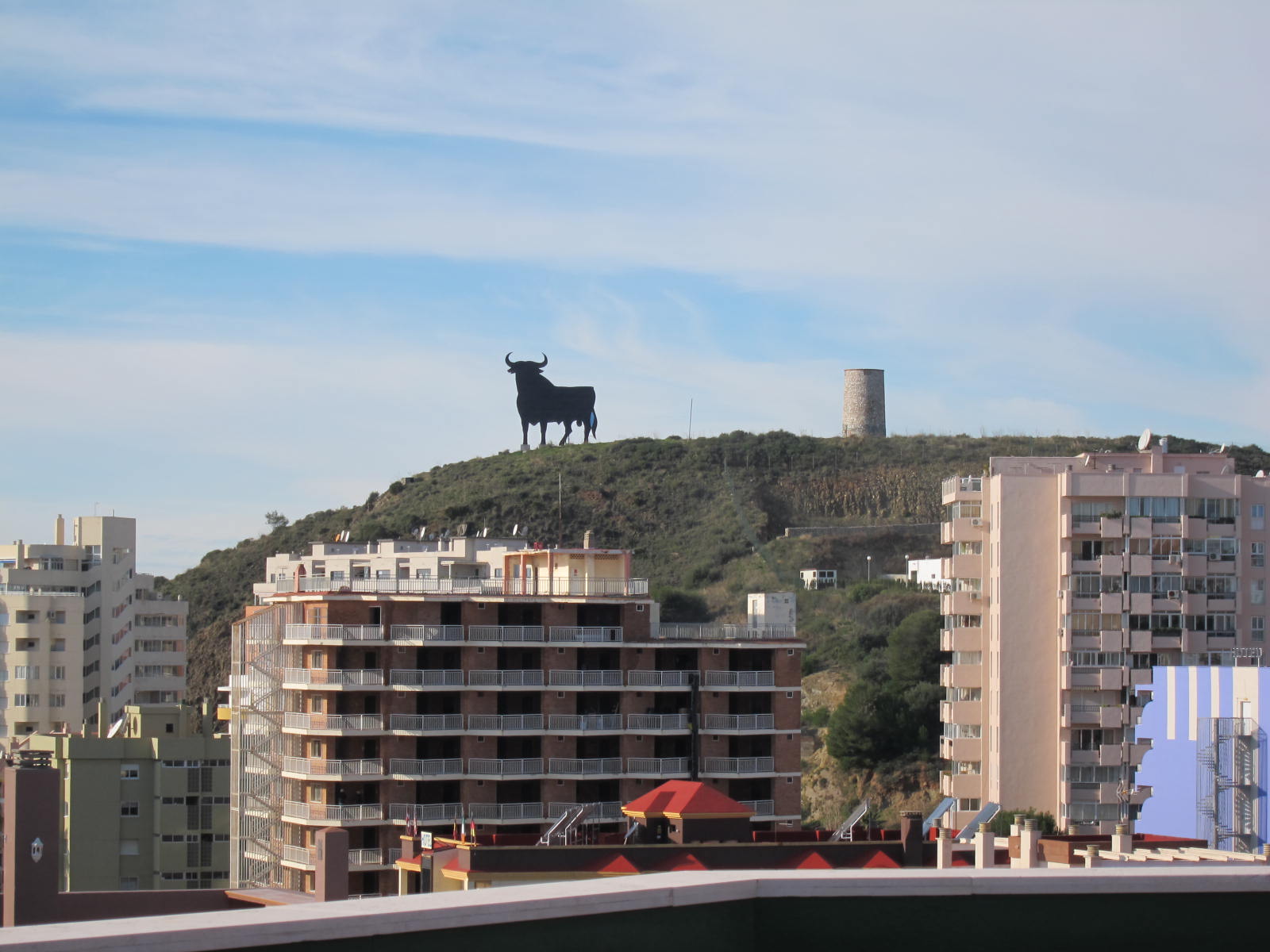
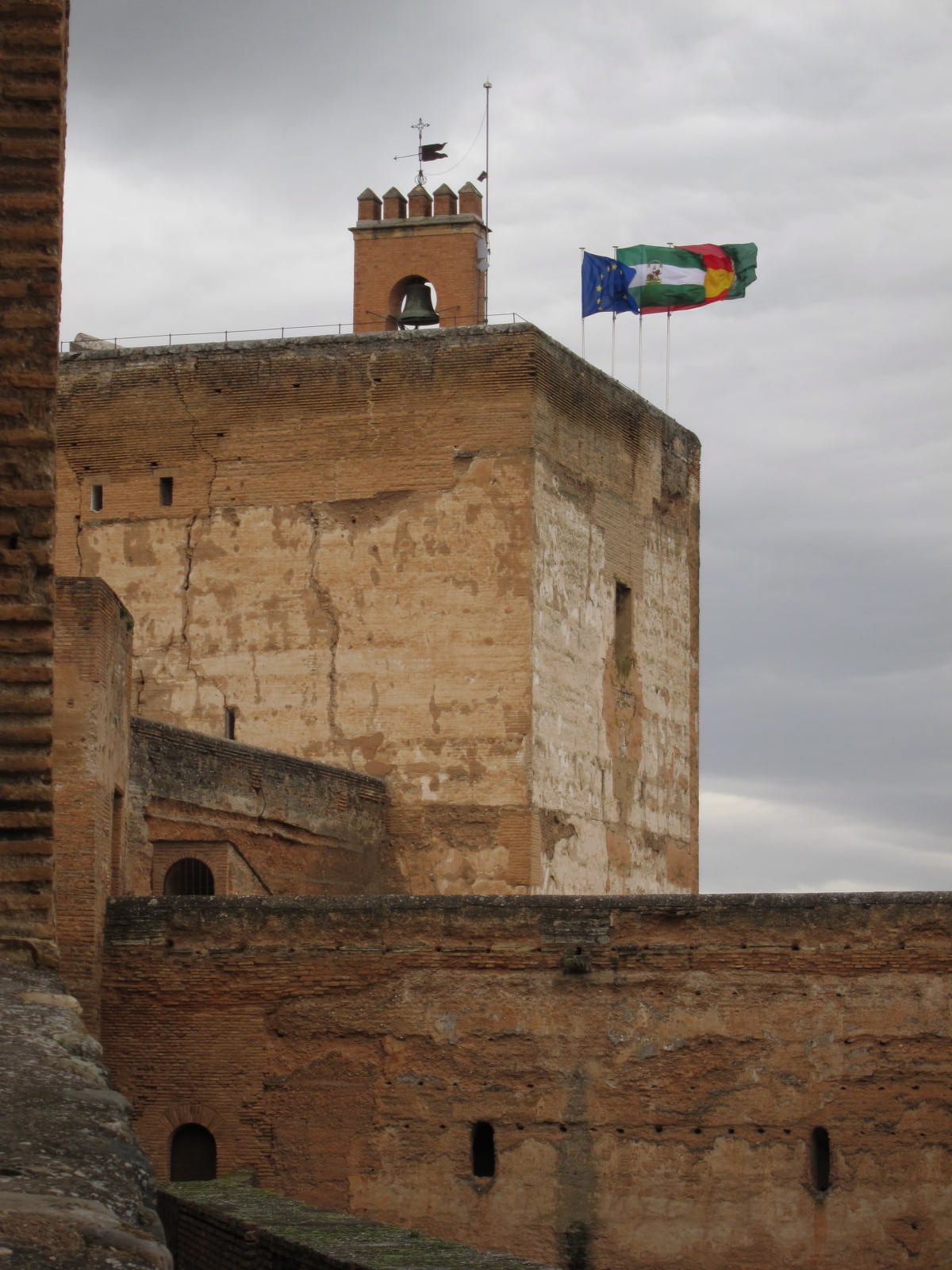
As a local attraction, we have our local bull totem overlooking us (I’ve named him Pepe). Over the months we spent here, Pepe became rather like a patron-saint for me. And there's our local fortress (castle, some call it): the Sohail, It's been an ancient fortification since the early Phoenicians, then Punic, then Roman, then Muslim to now. Its current form is Moorish in design, with archaeological digs still occurring. The most recent feat of note for the fortress is its role in the Napoleonic wars. The troops of Napoleon (not always French) occupied the fortress for a couple of years until the Spanish troops regained it in 1812.

One of the interesting stories about the Sohail concerns the battle of Fuengirola during the Peninsular War. It was fought on October 15, 1810 between a small Polish garrison and a joint Spanish-British corps under Lord Blayney. When asked by the Brits to surrender his post, Polish commander Mlokosiewicz replied in true cowboy fashion: "Come and take it!". Less than 300 Poles defeated 1200 British infantry, captured their guns and commander Lord Blayney.
Read more.
I'd say there isn't much to see at Sohail now. But then we chatted with a retired British army-man we met there. He had with a penchant for military history and was fascinated by Sohail's history and changing functional architectural design. One can always learn.
Being so near to northern Africa has made Fuengirola both a strategic and trading outpost for centuries. That reminds me: we also drove to the rock of Gibraltar, still British despite Spanish claims. It made me claustrophobic to be “on and in” the Rock, but it’s quite impressive, seen almost anywhere from the southern coast of Spain, especially from Terifa, the southernmost city in Europe. Ferries from there travel regularly to north Africa. I remember being on one years ago in a tour-bus with Spanish tourists headed to Morocco.
Today's Painting


 To COMMENT from the homepage: Click on Title of Post to get to its own page. Comment box appears below post. Subscribe for updates on art, travels, and adventures in creative life. You can also find me at my Facebook Page and Website for my art and news of upcoming shows/sales.