jquery paste

Showing posts with label Spain. Show all posts

Tuesday, June 7, 2011

The Rock: Gibraltar

Did you know that you can see Africa from Spain? Yup, sitting at a cafe in Tarifa and looking right across the Strait of Gibraltar... there it is!

Africa is less than 10 mi (16 km) south of Spain at the Strait of Gibraltar. Being so near to northern Africa and bordering this water bridge between the Mediterranean and the Atlantic has made Spain a a strategic spot for trade and conquest for centuries. This brings to mind the interesting convergence of geography and political coincidence that subsequently becomes ‘historical destiny’.
If not for this meager geographical distance, Spain, originally inhabited by Celts, Iberians, and Basques and annexed to the Roman Empire in 206 B.C. when Scipio Africanus conquered it, might have become more typical of other Mediterranean-European countries that also endured the decline of the Roman Empire and its subsequent barbarian invasion by  Goths in the early 5th C.

But just a short distance makes a tall difference to history, even with Gibraltar looming large. In 711, only about 100 years after the death of the Prophet Mohammed, the Muslims under Tariq entered Spain from Africa and within a few years consolidated their rule, concentrated in the territory they called Al-Andalus (Andalucia). All of Spanish history and culture was thereby changed and made unique within Europe, as I’ve noted throughout my postings.

Geography isn’t everything, of course. There was also that surprising feat accomplished by Columbus in 1492, with a little venture capital and a “what’s to lose” empire-building attitude of the reigning Catholic Monarchs of Spain. So happenstance should also get credited for much in history-making. 

What if the Italians had been just a bit more supportive of their native son? Perhaps they, not the Spanish, would have ruled the seas for the next century and italianized the 'New World'. Maybe pizza would have come sooner. But the Italians had their chance, and remembering the Romans, did their imperial bit. Still, there’s a statue of Columbus in the harbor at Genoa, and I bet a lot of sour grapes have been passed over that particular missed opportunity. 

No empire retains hegemony. Not the Roman, nor the Islamic rule of Spain in the middle ages, nor Spain's Catholic Monarchy (subsequently claimed by the Hapsburgs), which did have a pretty long run at managing and mismanaging the largest empire in the Western world for three centuries

Continuing our coincidental "what-if" thinking, if there hadn’t been a terrible storm, perhaps the ‘invincible’ Spanish Armada wouldn’t have been beaten by an inferior English fleet in 1588, again dramatically changing the history of Europe and the colonization of North America. 


Still, Spain remained the most powerful state in Europe and the foremost global and colonial power during the
16th C and the greater part of the 17th C. By then, depleting its enormous wealth in religiously-slanted wars and embroilments in Europe and elsewhere, Spain was on the road to losing much of its empire. Under its increasingly inept Hapsburg rulers, Spain  declined as a major world player in the late 17th C. For more historical insights, click  and click.

We spent part of the morning walking around Tarifa, the southernmost European city. Billed as great place for wind-surfing and having some nice beaches, it provided a pleasant a way-station for us. I'd been there once before, the only non-Spanish person on a rollicky Spanish tour bus headed for Morocco. That was a trip in itself. But now, we were driving via ferry to the Rock itself: Gibraltar. 

Tarifa is  a small town with the remains of fortresses and monuments to skirmishes during the Spanish 'crusades' against the Moors. This little fishing town was the first point of the Moorish invasion of Southern Spain in 711 AD. There's a statue to  Guzman El Bueno who in defended the town against the invading Moors in 1295.


According to the local story the Moors captured and threatened to kill his son if Guzman didn't surrender the town. Dad refused, throwing down his sword -- with which they killed his son. The statue is near a nice little family park. There were kids riding tricycles, and I thought about this story. How good was Guzman the Good? Would you really want a hero who loved his patriotic principles more than his son?  If only our capacity for joy were developed as highly and endorsed as much in principle as our capacity for war.  


Today's Thought

It is always easier to fight for one’s principles than to live up to them.
-- Alfred Adler

Patriotism is your conviction that this country is superior to all other countries because you were born in it.
-- George Bernard Shaw

The principles which men give to themselves end by overwhelming their noblest intentions.
--Albert Camus

Tarifa is still a major port of entry, now mostly for tourist ferries to and from North Africa. Local fishermen still use the ancient Almadraba method of fishing using a circle of boats and nets. Tuna fishing is big during its season (end of March-June). It's still a charming place for a stroll.

We had a seafood lunch at one of small outdoor restauranta lining the port and watched our ferry near shore. Sitting where the Mediterranean Sea meets the Atlantic Ocean, on a clear day one can enjoy spectacular views of the Rif mountains of Africa across the water. To give you an idea of how close it is to North Africa, the fast ferry Tarifa-Tanger  takes only 35 minutes. That's less time that it takes most of us to drive to work.

The rock of Gibraltar, one of the Pillars of Hercules in Greek mythology, has been a constant landmark for  thousands of years. Photographs cannot prepare you for the Gibraltar's physical impact. You see it looming miles and miles away on the shores of Andalucia. But as you approach it, its massive scale becomes overpowering. It's been described as "a 1,396-foot-high boulder - sheer on one side, a city of 30,000 clinging to the bottom third of the other"
Oddly, there's no mention of Gibraltar on the directional signs along Spain's coastal expressway. You see the rock right in your face before you know how to reach it. You figure this out t by going as far as you can toward the sea.


Gibraltar is British, despite continuing Spanish claims. The Rock was captured and ceded to the British crown in 1713 during the War of the Spanish Succession. Spain made repeated military efforts to get it back and now relies on diplomatic means. The population of Gibraltar, who speak both English and Spanish (often in the same sentence) recently (2002) rejected a referedum for joint Spanish-British sovereignty. 


Gibraltar is a tourist attraction. But on the cloud-covered afternoon of our visit, it made me claustrophobic to be on and in the Rock. There are buildings inside the rock as well as on top of it. The streets are narrow and much seems underground or perching on impossibly narrow and crowded little grey roads with high grey walls banking them. Military establishments and personnel also seem to be everwhere.


The  British pound is the ruling currency. There’s British whiskey to buy, along with dry goods from Marks and Sparks if you’ve been longing for them. We didn’t stay for too long, getting a bit of a dungeon feeling. Yet, the Rock itself is quite impressive viewed almost anywhere from the southern coast of Spain -- which is from where I’d rather view it. But, my view is idiosyncratic, as always. If you want some more positive tips on it as a tourist destination, check out this NYTimes article.

I want to leave you with a warning. Spanish ice cream can be hazardous! An ice cream bar can cost you more than $50 in Spain! That’s if you happen to eat it while driving your car. It happened to us. I couldn’t believe it. True: it’s the law and that’s the fine. But, when it’s usual for cars to hurl way past the speed limit, their drivers glued to cellphones (also against the law) and routinely crossing lanes without signals and with only inches to spare, it's rather sardonic to fine someone for pulling out of parking spot with a ice-cream bar in his mouth! Chalk it up to experience.
JS photo
This may be my last posting about Spain. So let me leave you with another photo of my dear totemic Pepe enjoying the Andalucian sunset. 


It is  always such a different experience actually to meet people on a one-to-one basis than to read their history. Spain is a land of so many contrasts, geographical and political: the rapacious extremes of the Spanish Civil War still remaining a potent example. Yet all the Spanish people (young and old) that we’ve met casually in our travels across regions of the country have so impressed us with their friendliness, readiness to offer help, easy manner and welcoming attitude that I’ve come to form a genuine stereotype of the “gracious Spaniard.”
Today's Painting
painting by Janet Strayer, see more click here
It’s been so easy for us with local citizens, even in large and bustling cities. Another thing we’ve noted is how indulgent (as well as attentive) Spanish people seem to be with their kids, and even other people’s kids. The little ones here seem not afraid of strangers (one might worry, but their parents let them roam within view) and we’ve had several come over to us in cafés, smiling and checking us out. 
The kids (even toddlers) are out with their parents at all hours of the night, being taken to pubs at 10 pm, which, as you know by now, is the time many Spaniards take their evening meal. They’re an energetic bunch, to say the least.  And, as the Spanish say often in Spain, it's a place where se vive bien. My sentiments exactly. Well, viva España! I’m glad to have had some opportunity to get to know it better. 


post signature To COMMENT from the homepage: Click on Title of Post to get to its own page. Comment box appears below post. Subscribe for updates on art, travels, and adventures in creative life. You can also find me at my Facebook Page and Website for my art and news of upcoming shows/sales.

Sunday, June 5, 2011

El Refugio/The Refuge on the Costa del Sol

After our trips to  different places in Spain, we’d come back to our welcome home in Torre Blanca. Each time, as we approached warmer weather, the locale seemed to be getting more and more resort-like. By the time we were getting ready to leave Spain in mid April, it was brimming with sun and sunbathers. We could smell the coconut-scented suntan oil wafting up to our 10th floor balcony.  Walking along the sea promenade was still a great pleasure for me, as was winding our way into Los Boliches to the small café I liked so much, its owners becoming more like friends. 

The sea is so prominent here that it’s good to remember there are some fine areas to explore in the surrounding high (and much cooler) hills. El Refugio (Jualan) is a nature reserve not far from Marbella that we’ve enjoyed visiting several times. 

Located not far from the beaches, it nevertheless is a climate away… and is aptly named a refuge.  Situated in the woods at sufficient altitude from the sea to be several degrees cooler and, with its forested grounds, it serves as a haven for the sun-drenched and beach-besotted. We visited several times: once in early March it was bracingly cool with strong winds but sun shining. We had it nearly to ourselves. But just a few weeks later in March it was very sunny and the long walks and hikes were often frequented by families.

After walking about a mile on a well-travelled path, you come to “the end”, as seen in the photo. Actually, it’s just one of the buena vistas to look out and down from. Yes, indeed, I’m happy to have been able to take my first (mini) hike in so long! 

I had to use walking sticks, still unable to trust my footing or balance. But rest assured: most people can easily manage the less arduous trails around El Refugio. There are also some more challenging hikes for the enthusiast. And the trails tend to be well-marked here… in contrast, say, to hiking in France.
El Refugio trails


French hiking guidebooks are notorious for telling you how long a trail should take you (if you are a marathoner!) but neglect to say how many kilometers it measures. I’m remembering how many times I’d get lost on hikes taken in southern France, trusting to my little French book written for randonneurs. The book would typically have some toss-off directions in French, telling you, say, to veer right of  “some stone vestiges of what was perhaps an old Roman encampment.” First off, how does a foreigner who’s not an archaeologist have the faintest clue of what “some stone vestiges” are supposed to look like? Secondly, the trail is filled with all sorts of stones and, having followed earlier such instructions, I’m usually hopelessly off the trail by now, imagining bread crumbs strewn along the path to guide me home again. Nevertheless, I’m still here to tell you about it. 
Looking up to the hills near the buena vista spot is a fine bronze statue of a mountain goat that takes you by surprise. 
JS Photo
I, who tend to name nearly everything, named her Millicita, a homage to a famous little mountain goat on Saturna Island who was born in 2000, named Millie by a friend of mine who reared her and introduced her back into her tribe of cliffwalkers on that mystical little island. That goat, despite all the differences in climate and culture, of course, reminded me of home at Saturna. But I’m not homesick. I'm just thinking of how lucky I am.
Today’s Thought
Most new discoveries are suddenly-seen things that were always there.
Susanne K. Langer


Today's Painting


painting by Janet Strayer
Walking around El Refugio is a welcome reminder of how simple pleasures can be. Taking the time, one step at a time, to enjoy all that surrounds us, to notice how the air feels, see the colors shift, to enjoy others or one’s own company, the remarkableness of feeling alive in the world. 


post signature To COMMENT from the homepage: Click on Title of Post to get to its own page. Comment box appears below post. Subscribe for updates on art, travels, and adventures in creative life. You can also find me at my Facebook Page and Website for my art and news of upcoming shows/sales.

BARCELONA

We won’t leave Spain without visiting one of my favorite cities: Barcelona. It is a modern, hip city filled with vibrant energy and lots of interesting sights. If you were plunked right down into in, I’m not sure you’d know exactly where you were in Europe. It’s definitely not Kansas, but not necessarily Spanish either (as I’ve come to know it, anyway). Barcelona buzzes like a place on the move and dances to its own inventive rhythms.

Barcelona is Catalan, with its own culture and language (street signs here are in both languages), though it is not demanding independence from Spain, in contrast to the Basques. The Catalan language seems at least to be accessible to reading if you know Spanish and French… again in contrast to Basque (see my posting on Bilbao). It would take a more politically astute person than I to explain why. But possibly, they already have possession of what they want. 
Architonic, painting by Janet Strayer, click for more

To me, not conversant in local politics, Barcelona (and other Cataluñian places we visited), seemed quite thriving in a sense of individuality and self-determined development, as well as in receiving favorable public acknowledgement within and outside of Spain. Perhaps this contributes to making Cataluñia less strident in its politics than what we hear of Basque independence demands. 
 Today's Thought
The creation continues incessantly through the media of man....
But man does not create... he discovers. 
--Antonio Gaudi

The great quality of true art is that it rediscovers, grasps and reveals to us that reality far from where we live, from which we get farther and farther away as the conventional knowledge we substitute for it becomes thicker and more impermeable. 
--Marcel Proust

Like most fairly big cities, Barcelona has many concrete apartment buildings and offices comprising rather uninteresting sections of town. It also has pollution, but is trying to get green. The air seemed very clear when we visited. Mostly, though, it’s a city tuned to its own heartbeat, which beats strong. It’s upbeat, vibrant, young in outlook, easy to live in, except that everyone walks so fast. 

See all the fabulous Gaudi you can take in  (not only the Sagrada Familia, which must be the most unusual cathedral in the world. Gaudi’s personal take on Art-Nuveau Gothic is always an adventure. 

 Guell Park is a welcome outing within the city, much visited by locals and tourists alike Gaudi's dream-like park, with fine views of the city. The park boasts both a set of gardens and architectural complex atop El Carmel hill.  La Torre Rosa, Gaudi’s former home (now a museum) has interesting features inside and out. 

See also the random buildings Gaudi designed around the city as you walk. They are scattered treasures among its apartment houses. Call these structures interesting, organic, weird, inventive, whatever. But they offer quite nice surprises. People must enjoy living in them, and I’d like to have met someone who does. 

The challenge of designing city housing that doesn’t look like a vertical mausoleum seems a big one. But Gaudi has certainly met it, as has another mystical artist-architect: Fritz  Hundertwasser in Vienna. I suppose some will find their works off-putting or even a bit Disneyesque in the midst of grey and humorless city facades. 
But I’m all for it.  


In addition to all else, Barcelona has the best tapas we’ve eaten. I had the best and most diversely yummy selection of tapas at a very nice fine restaurant  with an unassuming name (Cervezeria Cataluna?).You can sit at the large tapas bar, with the beautifully presented dishes all around you under glass. Or you can go into the formal dining room and have a full-service dinner, including your selection of tapas.  It’s located somewhere near the Astoria Hotel. Ask the friendly-helpful desk staff there.


 The Astoria Hotel reminds me of a better kept version of the Chelsea Hotel (NYC), with a similar artsy history. All the people in Barcelona seemed friendly and lively and ready to help, even though they rush around a lot. Here's a photo I took looking down upon its elegant staircase:

Barcelona has a good assortment of art museums, contemporary and traditional  (*the Cataluña), Its shops are inviting, including some stylish clothing. Very trendy, very much its own.  Walking  around the city is interesting, particularly Las Ramblas with its street performers -- like a brighter, more upbeat NYC.
street performers on Las Ramblas when I visited (JS)
Walking along the wide boulevard known as Las Ramblas, one is treated to lots of good street performers. I’d hoped to view original paintings on display there as well, but maybe it wasn’t yet the season. I guess I’ll have to come back!


post signature To COMMENT from the homepage: Click on Title of Post to get to its own page. Comment box appears below post. Subscribe for updates on art, travels, and adventures in creative life. You can also find me at my Facebook Page and Website for my art and news of upcoming shows/sales.

Friday, June 3, 2011

Ronda and La Pileta Cave

Here we are in Ronda, a place like no other in Spain… or elsewhere. It’s only a day-trip from the Costa del Sol but is  nothing like it. Ronda is built on top of a sheer and spectacular gorge (El Tajo canyon). The setting alone is beyond belief, with the city connected by a stone bridge spanning the drop (called the New Bridge, it’s over 250 years old). The height and angle are so dramatic that, standing atop the bridge, you can watch kites (the birds) dive and swoop in a flash.
all photos by JS
Why would folks so many centuries past have thought it worth the enormous effort to build such places (I’m recalling Minerve in France as well): defense? Yes, but they also built some places so well that they not only resist and endure but, in the case of Ronda, retain a civilized life. One can easily explore much of hilltop Ronda on foot, and there are good paths and steps down to the cliff-face, requiring some stamina and good joints.


Ronda is considered the birthplace of modern bullfighting and its bullring was famous even before Madonna made a music video there. It’s also been an equestrian training centre since the 16th C when no less than king Philip II established the Real Maestranza de Caballeria, a training facility for developing horsemanship.

The air seems rare and rather refined. And then the city, with its ancient bull-ring (a favorite of Hemingway) and elegant Parador, parks, and antique shops is a welcome find somewhat off the well worn tourist track.  It’s had its bevy of famous visitors throughout history, including Orson Wells, who said he was happiest in Ronda and wanted his remains left there (the gorge would have big enough to accommodate even his considerable bulk).

By the way, paradors are among the very best hotels to stay in throughout Spain. One of Franco’s limited good ideas, they are nationally subsidized beautiful hotels (in former ducal palaces and similar grand squats), so are usually reasonable for what one gets. The large rooms and services (like restaurants) are exceptional and the views are usually the best that can be. Our room in Ronda had a lovely stone balcony (photo below) and other hotel windows looked vertiginously down upon the gorge.

Ronda is billed as one of the most ancient and refined cities in Spain, with its equestrian tradition and sedate squares, in addition to one of Europe’s oldest bullrings. Walking around the city, one finds that it was headquarters to the Spanish Inquisition and later, for a time, to Franco’s regime, rather marring my stellar memories of it. The high terrain was once also home to bandoleros, seen recreated, in dress at least, in this photo. Bandoleros and majas, their colorful dress, music, and festivals were for a long time the subject of romantic paintings set in Spain. The new Sofia Thyssen museum in Malaga has a good collection of these.

I was enchanted in Ronda by a princess I met in an antique shop I visited. Looking into a back room of this rather stuffy place, hoping I could find some inexpensive picture frames, was a lovely little girl of about five, wrapped in a blanket and twirling around. She stopped and smiled at me, asking in Spanish why I walked with a cane. I told her and she shook her head sadly, then resumed smiling. In response to my asking her name, she told me it was Princess Ariel. So I bowed to her and told her I enjoyed my audience with her. Sometime, I will paint this golden little girl, or perhaps, in some form, I already have.  
Today's Painting
painting with gold leaf by Janet Strayer see also www.wix.com/janetstrayer/paintings


Not far  from Ronda (about 22 kilometres)  is something strange and magical. It’s the Cueva de la Pileta (Pileta Cave, near Benaojan). I tried to visit it the first time we went to Ronda, but I couldn’t make the steep rocky walk up to it. Jim went on his own at a later date, noting that even if I had been able to climb up, I could not have managed the trek into the cave. So, it is not for the physically challenged. Below is the bottom of the hill to the cave entrance.
From all I hear (and the book from the cave), La Pileta is well worth a visit. It’s in as near its “natural” state as any such treasure can remain, once open to visitors. The little book bought on site is a marvel of detail about the Pileta Cave and its history. It tells the unique story of the tough and resilient Lobato family whose grandfather (Jose Bullon Lobato) discovered the cave in the early 20th C. The family became La Pileta’s guardians, endured travesties on its behalf, and still serve as its caretakers. The current guide is the still-nimble grandson of the man who first discovered the cave .Though it’s now recognized as a national historic site, the family still tends the cave personally, arranging limited tours.

I’m told, first-hand, that the decent is steep and slippery, with no light but for the lantern held by Sr. Lobato and a flashlight he uses to point out formations during the 90 minute tour of the extensive cave system so far unearthed. If you’ve ever been in any cave, you know how truly dark the utter dark can be. Sr. Lobato’s lantern is reminiscent of his Paleolithic predecessor, who carried a fired pitch torch into the cave. Then, as now, one must rely on only a little light and one’s own footsteps to guide one ever further on.  Not everyone chooses to explore the dark.

The paintings in an inner chamber of the cave system include a fish as well as other animals and some stick-figure humans. Human remains have been found dating back at least 30,000 years. Researchers believe this cave is part of an extensive system of caves at the crossroads of human migration during Paleolithic times. There’s an excellent site (in Spanish) for viewing some of the Pileta’s mystery: the videos need no translation (click here).

So here we are, still in wonder at it all. We’ve been to the heights of a city balanced atop a precipitous gorge.  And then we’ve been to the depths of a steeply descending cave to glimpse a civilization almost lost to historic record. Civilization and nature, bound together, however they endure.

Today's Thought
Darkness within darkness. The gateway to all understanding.
  -Lao-Tzu
We modern men are not 'modern' at all. On the contrary we still belong to the last generation of cave dwellers.

Friday, May 27, 2011

Seville and Flamenco: the Sacred and Profane

And then there’s Sevilla (Spanish name) capital of Andalucia and ancient city of dreams. The historic  center of this colorful and fragrant city presents an ornate and romantic city filled with orange-trees everywhere, and gitanos/gypsies everywhere, some still living in the pre-historic caves in the hills around Seville… now adorned with curtains.
all photos by JS

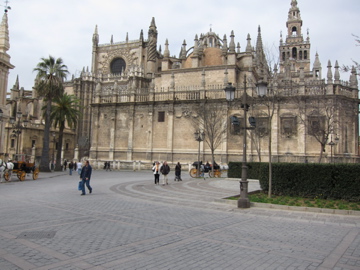
square in the ancient part of Seville, Spain (JS)

It’s a city famous for its huge bullring (think Carmen), its gypsies (think Carmen), its flamenco (think Carmen), its intense oranges, and its huge over-the-top cathedral, the enormity and seeming haphazardness of which I cannot possibly convey to you by word or photo. In it, Columbus is buried in grandiose style, nothing in this cathedral being less than grandiose. It’s the largest cathedral in Spain and the third largest in the world (after St. Peter’s in the Vatican and St. Paul’s Anglican). Having shown you some of Burgos in a previous posting, you get some idea of how immense this even larger one is: really, really BIG!

By the way, if you haven't seen Bizet's Carmen, go get the opera film. It's one terrific musical-drama. It was the very first live opera I was taken to see (by my parents' friend and  piano teacher who despaired of my ever getting in tune)... and I still love the feistiness of that 'bad' girl heroine. (Bizet wasn't Spanish, so how could he have  known it's "torero", not "toreadore. Then again, I guess in lyrics it's fitting the beat that matters most). 


This is a major altar in the Seville Cathedral... the figures are life-sized or larger, so get an idea of its scale!
Much of the Cathedral is done in the plateresque style (plateresco), which is typically Spanish, and exported to Spain’s colonies in Latin America. Literally translated (plata = silver), it means "in the manner of a silversmith".  It’s  characterized by profuse and lavish applications of delicate low-relief ornament in a variety of motifs, including Gothic, Renaissance, and Moorish design. Gilding and painted surfaces are included in the elaborate ornamentation.

Seeing this style so often in Spanish cathedrals made me wonder if the elaborate excesses often characterizing a Spanish girl’s Quinceañera could derive somehow from this long-standing Spanish tradition for ornamental display. 
Columbus's tomb in Cathedral of Seville (larger than lifesize figures)

I got shell-shocked after walking into the Cathedral. It was too big, too disorganized, too much of too much for me even to get a sense of the awesome or profound or beautiful. Quite the opposite of a rush, I felt a drain. Although I saw some impressive sights in it, as the photos document, I might be the only person in the world not enraptured by this Cathedral and I feel rather sorry about it.
 Here's a fragment of a painting in Seville showing Hell. Why does Hell inspire so much imaginative energy compared to Heaven? the other side of this painting could be a depiction of people waiting patiently for a bus.

My sense of wonder and glee returned after entering the Alcazar Real (Royal Palace), only a brief walk from the Cathedral. The Christian monarchs, Alfonso X and Pedro I employed Moorish craftsmen to build it in the 14th century. It's a wonderful example of  Mudéjar architecture (a mix of Moorish-Western).  


This royal palace, once inhabited by Isabella and Ferdinand, is still inhabited on their visits to Seville by the present Spanish king and queen (Carlos and Sophia). Aside from the royal quarters, much of the Alcazar is open to the public to see its ancient treasures in paintings and architecture (mostly Moorish, again, along with renaissance motifs ). Columbus had one of his latter audiences with Isabell and Ferdie in this place, perhaps both impressed and daunted by what he’d started to roll. 
Mosaic tiles in Alcazar Real, Seville (JS
Moving easily from the sacred to the profane, we went to see a Flamenco performance that same evening. I think I must have gotten hooked on Flamenco when I was an infant and  saw Julio Greco on the Ed Sullivan show. Such restraint in the midst of conveying strong emotion still gets to me. I don’t like bull-fighting; but I do think of the stamping movements in flamenco as embodying something of the bull’s pent-up rage. Similarly, the taught push-and-pull movements of pairs of dancers conveys an energy related to taming, while at the same time expressing, our animal/sexual nature. I’m sure there are dissertations out there on the "meaning” of Flamenco. But I just enjoy it: the music, the singing, the dance. It’s not happy, but there is so much energy and vitality in its pulse.
Today's Thought
Music expresses that which cannot be put into words and that which cannot remain silent.
--Victor Hugo
I found an intriguing bit of information on Flamenco provided by the Frommers’ travel site, from which I’ll excerpt.  They mention connections between flamenco and the tragic fate of Spanish Jewry, suggesting that a Sephardic presence can be felt in flamenco music.  Flamenco took root after the  1492 expulsion and flourished underground. They state that many flamenco melodies are similar to Hebrew prayers, also noting similarities of the Hebrew “jalel” (to encourage) and the flamenco “jaleo” (the hand-clapping and shouts of encouragement accompanying the dance). Even the name flamenco (“Flanders” in Spanish) was how Conversos in Spain referred to the sacred music of their co-religionists who had emigrated to Flanders where freedom of worship was permitted. Who knows?


 I enjoyed staying in Sevilla. The hotel (Hotel Las Casas de la Juderia; photo at left) was a treat as were the small cafes and restaurants. People seem to enjoy living there. The unusual and highly rated hotel we stayed at was converted from a series of old houses  and retained some lovely old qualities along with excellent modern facilites and staff. 


Today's Painting


Cat & Hat, www.janetstrayerart.comhttp://www.janetstrayerart.com

post signature To COMMENT from the homepage: Click on Title of Post to get to its own page. Comment box appears below post. Subscribe for updates on art, travels, and adventures in creative life. You can also find me at my Facebook Page and Website for my art and news of upcoming shows/sales.