jquery paste

Showing posts with label music. Show all posts

Thursday, March 15, 2018

Taranto, Italy and the Dance of the Spider

Taranto 

You've heard of the dance, the Tarantella? Its origins are an oddity, and  it is linked to Taranto, a small city in Puglia, on Italy's Ionian coast. It's an odd distinction for a town, but that is its fate and fame. Another nearby city in Puglia, Galatina, with similar links to the tarantella -- plus some incredible art worth seeing--  is featured in a separate column here.  

Title still-shot of documentary, credits and link

The Origins of the Tarantella 

The peculiarity of the tarantella is that its origins are associated with a psychic disorder, a form of hysteria, known as tarantism that was recognized in Italy as early as the 15th C.  Tarantism has lingered on in isolated rural areas through the 20th C. This has been recorded n a documentary clip from nearby Galatina the 1950's and aired on TV by another off-beat traveller, Anthony BourdinYou can click here to see the original Italian documentary, La Taranta, which filmed incidents of tarantism occurring in the nearby countryside. Filmed in the 1950's, it looks much earlier in time and is quite different in its rawness from the holiday tarantellas celebrated in festivals now

Spider Bite or Hysteria? 

Said to be caused by the bite of a tarantula spider (a form of wolf-spider or black-widow), its victims  (mostly women) display distressed and feverish symptoms that include vomiting and sweating, fear and delirium, depression and paranoia. They are seemingly cured by a rite that involves feverish 'dancing' that can last for days. It's not so much dancing as it is impulsive, pulsing movement: jumping, hopping, gyrating upright or on the floor. The frenetic movements are accompanied by music played fast, in 6/8 time, with the pace of both music and movements reciprocally urging each other onward, all in  the company of  family and neighbors who attend the seized woman. The often delirious victim, with attendant crowd, eventually is guided to the local church where, still trance-like and tired-out, she is finally 'danced-out 'of her throes with religious help. 

A Fascinating History of a Malady and a Dance 

The tarantella has a fascinating history. It is thought that the town of Taranto, in particular, gave its name to the dance because a particular variety spider, popularly believed to be venomous, was common to this region.So, the dance was  named the tarantula.

Dancing Maenad on Vase by Python, 330 B.C. credits
The origins of the dance, however, may lie much deeper in history and cult. This dance is  speculated to be a surviving remnant from ancient rites of Diana or of Dionysius

We know that all of Puglia was originally more Greek than Latin/Roman. By early Roman times, Bacchanalian rites were suppressed, which may have driven them underground ... where they lingered and were transformed into another collective ritual in the cult of TarantismWhat is known for certain is that Tarantism dates back centuries in this region, appearing in early manuscripts. 

The music, originally played on  local  instruments  available  at the time (tambourine, drums, fiddle, accordion, guitar)  developed into folk dance forms. These dances became popular in several regions of southern Italy. In the Salento region, the dance is  also known as the pizzica

The tarantella also made its way to the more formal dance-floor for nimble-footed partners. And the stellar choreographer, George Balanchine, adapted it to ballet. Remarkable in its journey from dirt floors to concert halls, the tarantella also appears in the work of such dignified composers as Franz Liszt and Frederic Chopin. But the original  forms of the dance, very obscurely caused by a spider's bite, were inspired by each individual's almost hypnotically frenzied, trance-like movements in response to the dancer's delirium, then set to music's beat.

Archaeology in Taranto: the MARTA

We visited Taranto, the city etymologically linked to this curious dance, We were unlikely to see the tarentella danced today. Our motivation for visiting was to see Taranto's well-recommended archaeological museum, the MARTA. 

 a navigation scene with figure carved on cup, 2,000 BC

We were not disappointed. The MARTA  (Museo Nazionale Archeologico di Taranto) is  easy to navigate and fun to explore, with excellent staff to help, if needed. 
The access and lighting are modern, and the items just enough to give a sense of the particularity of each item and its context. The displays are very well presented (many in English and Italian), with computer-screens that let you look further into particular items and context. 

This is a museum you can appreciate, one that takes both its informative function and audience satisfaction into consideration. We left, feeling both intellectually and aesthetically satisfied. And maybe we even learned a thing or two. Especially notable is how much the language, artifacts, art, and customs derived from ancient Greece (magna-Graecia) and cross-cultural interactions influenced this southern region that is now Italy.

One of the reasons I love museums like MARTA, which focus upon what we call "prehistory" and "protohistory", is that they show as well as inspire a special blend of skillfully investigative research +
imagination in order to unearth, literally, what the displayed objects likely meant when they were fully alive. 

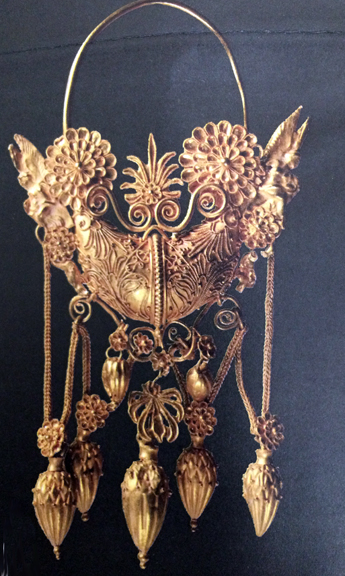
The museum is arranged chronologically as you walk through its levels. Here are some of the many intriguing and beautiful objects in the museum -- a random and non-chronological sampling from photos I took. They include 20,000 year-old figurines of a female/goddess, a polychromed head with its colours intact, anthropomorphic pots from the 6th century B.C., one of the most intricate gold earrings I've seen (4th century B.C.),  a nutcracker in the shape of black hands, representations of African faces ( 3rd-4th century B.C. cross-roads of many cultures), wonderfully designed functional pots from different epochs, and Medusa as she looked across ancient time.


Communication and Cross-Cultural Influences

It's a gift to us that a focus of  such museums is to illuminate the earliest forms communication within this region of multiple cultures. We come to appreciate the intents and meanings behind the many quotidian, functional, ceremonial, religious and just plain beautiful objects displayed. 

Given that there are no extant traces of the language that accompanied many of the objects  shown, we're left with marvellous clues to decipher: technological artifacts of the time, items relating to food production/consumption, houses and settlements, burial remains, ritual or ceremonial objects, human adornments, decorative motifs and representations (animal, human, gods), aesthetic styles, art. 

Almost any human act can have both functional and symbolic or ideological meaning, and meanings can change across generations and different communities. In this way, archaeology s remains a living story precisely because it remains open to be deciphered, by us  now... as it was then. 

Quite a time-travel adventure when we visited Taranto!

More Creative Life News

You can read and see more about Italy, plus other travels and creative adventures by this itinerant artist at Creative Life News click  https://www.janetstrayer.com

Regards, Janet 


Friday, May 20, 2011

Spain: TOLEDO

Today we'll visit Toledo: the city in Spain with olé in the middle of it; not the one in Ohio. You know, one of my more delirious ideas for a travel itinerary was to visit all the North American cities with hand-me-down European names. That is, cities in the US that were named for cities abroad: like Moscow, Idaho; Paris, Illinois; Madrid, Iowa; Berlin, Wisconsin; Vienna, NY; Baghdad, Kentucky; Seville, Ohio; Rome, Georgia;Naples, Florida;Venice, California, and so on.

My bright idea might have been great: a weird and whimsical venture following both the spirit of  'the road less traveled.' and the infallible reasoning of 'why-not!' But I let it pass. There's a lot to be said for well-traveled sites: most of us really do want to see them! It was absolutely true that I did want to see Toledo in Spain ... though I still remain indifferent about the one in Ohio.
View of Toledo by El Greco
My first sighting of Toledo was as a dream-city. I first saw it when I was a girl in New York looking at  El Greco's View of Toledo in the Met Museum. I was transfixed. Toledo looked unearthly and magically dramatic, lifting up in an undulating wave into a tempestuous sky. It almost made me sick. But I kept wanting to look at it. These days, some works in  El Greco's  exaggerated style seem a bit much for my aesthetic taste: the swooning eyes, the elongated boneless bodies, the electric colors. But the sense of wonder inspired by that painting remained (as did my own leaning towards expressionism as a painter). I wanted to see a city that could be made to mean so much.


Driving upward and winding along the Tagus River, Toledo still looks somewhat like El Greco painted it. In the daylight it glows golden-white against the olive-coloured hills. It retains the character of both an ancient city and a bright, cared-for place in which people seem to live comfortably among the orderly little squares and parks. 


It was March when we visited. I was surprised by how many tourists crowded it’s upper cobblestoned area.  We hadn’t yet encountered large numbers of people on our escapades. Capital under the Romans of what was then Spain, Toledo remained the capital of Spain from the Gothic epoch until 1560, a fact that explains its impressive medieval architecture. Walking through the streets of this walled city is like stepping back into the Middle-Ages – but for all camera-slung tourists in New Balance shoes.

Touted  as a ‘city of the three cultures’ (Christians, Arabs and Jews lived together there for centuries), Toledo preserves an artistic and cultural legacy in the form of churches, palaces, fortresses, mosques and synagogues. Toledo seems a city of historic sentiment, for Catholic and Jew, as well as Muslim.   
Toledo’a rather impressive Gothic cathedral reflects the Spanish-Gothic style and moves stylistically through to the Baroque during the 250+ years it  took to  complete. The Cathedral stands on the site of the Great Mosque of Toledo, which itself had replaced a Visigothic church. I’ll be showing photos  of other magnificent cathedrals in some greater detail in later posts.

Notable synagogues were also built in Toledo during an all-too-brief epoch when muliple cultures flourished and intermingled in the same terrain. We visited two famous ones with lyrical carvings along their walls and columns, reflecting a Moorish architectural influence -- but not nearly so elaborate as the fabled Alhambra or the many cathedrals with their Mudejar (Moslem-influenced Christian) style.

Of 11 active synagogues in Toledo before the 1492 expulsion; only two remain today as museums. One  beautifully illustrated book on ancient synagogues is by Samuel D. Gruber (click).

The first we visited, Sinagoga de Santa María la Blanca, built in Toledo in 1190, is generally considered the oldest synagogue in Europe still standing.
 Converted to a church in the 15th C., it’s now restored with elements of both and functions as a museum. You can see the Moorish influence in its molded plaster designs and horseshoe arches, with a Romanesque-like shell, typical of Christian churches highlighted, as well.

The second and more elaborate is the  Sinaagoga del Transito,  founded about a century later, with some beautiful inscriptions in Hebrew atop its carved plaster walls. These remained when it was made a church soon after the explusion 1492. It’s now a nicely arranged museum presenting historical and archaeological facts and artifacts relating to Sephardic Jewish history. Toledo was a center for Sephardic Jews in terms of both religious and cultural identity and and in terms of earning a living in the learned professions and in craftmaking (jewelry and embossed metal and leathers).


Toledo is also famous as being the adopted home of El Greco (541–1614) and is the subject of some of his most famous paintings, including “The View of Toledo.”

Born in Greece, land of Byzantine icons, El Greco rejected naturalism in painting. Famous for his figural paintings, he is one of the least corporeal of painters. Publicly disparaging the paintings of Michelangelo (losing him favor at Italian courts), El Greco’s unique stylistic virtuosity presents a duality: both a forward-looking aesthetic (emphasizing intellectual-spiritual expressivity) and a backward-looking convention (the exaggerated artifice of the Mannerist and even earlier Byzantine style).

Yet, El Greco persisted in his own vision (“I paint because the spirits whisper madly inside my head”), creating highly elongated, twisting forms with radical foreshortening, and using unnatural colors in a deeply expressive manner all his own. (Read more).


Despite his always signing his Greek name, Domenikos Theotokopoulos, I think of El Greco as a quintessentially Spanish painter: infused with a mystical religious sentiment, stylistically expressive, highly individualistic and proud, determined in his own aesthetic vision  He was elitist in his view of art:“The language of art is celestial in origin and can only be understood by the chosen”. Yet his paintings today remain among the most popular and easily recognizable of past masters.His personal take on art reflects a credo for the “tortured and artistic soul’, also stating that "Artists create out of a sense of desolation" and "The spirit of creation is a excruciating, intricate exploration from within the soul." He was perhaps just slightly meglomanical to boot: "I was created by the all powerful God to fill the universe with my masterpieces." But these excerpts give us a glimpse into his own understanding of his artistic inspiration and mission. 

Today’s Thought
You must study the Masters but guard the original style that beats within your soul and put to sword those who would try to steal it
– El Greco
My  romance with El Greco ended in my early youth. Now in late youth, he's not among my personal top 10. But he remains unforgettable.  

Not only visual arts, but music also flourished in ancient Toledo. It was a major cultural center during the reign of the Catholic monarch, Alfonso X.  Born in Toledo, he was a Renaissance man before the Renaissance. Alfonso was called "El Sabio" ("the Wise/Learned", 1221-1284). True to his name, he founded universities in Spain (Salamanca and Toledo), continued the excellent tradition of The Toledo School of Translators, rendering great academic and philosophical works in Arabic into Latin. He had the Castilian language codified in both written and spoken courtly records, and himself composed a history of the world in that language. I imagine he was a light sleeper, spending his spare time writing poetry when not busy with  treatises on astronomy or authoring codes of law.

Not quite an equal-opportunity employer, Alfonso nevertheless employed Jewish and Muslim as well as Christian scholars and made his court a multicultural haven for artists, scientists, and musicians. He himself composed poetry and learned treatises. He was an ambitious politician, but the Papacy prevented his confirmation as elected ruler over the Holy Roman Empire. Perhaps remarks such as the following may have contributed to their pique. Alfonso is reputed to have said, during a discussion of Ptolemaic cosmogy: Had I been present at the Creation, I would have given some useful hints for the better ordering of the Universe.

Famed for his interest in science and prolific writings, Alfonso X also liked a good song. He commissioned or co-authored numerous works of music during his reign.  I remember being transported during a secondary school Spanish class  when our teacher played recordings of (lute and guitar and vocal) music from his court. That’s probably why I even remember Alfonso so fondly now!  My original vinyl album is somewhere in music heaven, but here’s an internet source for you (click), or check medieval music sites. 

Alfonso’s court's poetry and music are intact in sumptuous illustrated manuscripts. This poetry and song have been related to the Provençal lyrics of the Troubadors, many of whom took refuge in Alfonso's court during the Albigensian Crusade (another reason the Papacy was irked). The manuscript illuminations he had made document the vibrant musical life of his court: its images record some 40 different musical instruments played by nobles and commoners, women, Jews, and Muslims. His will bequeathed the Cantigas de Santa Maria (an elegant collection of songs relating to the Virgin Mary) to the Cathedral of Toledo for singing on Marian feasts, a custom that still takes place.

Today’s Food
If music be the food of love, ... so is food. (JS)

I didn 't want to leave Toledo without mentioning that it is also famous for its marzipan sculpted into animals. These were sought after even during the Renaissance, when records indicate that the court housing Leonardo himself gobbled them up faster than the artisan sculptor could make them.

Another famous dish I ate in Toledo was estofada de perdiz (click for recipe), a delicately flavored casserole made of wild partridge. I saw on menus, but reserved for another time a popular dish, judias con perdiz, a bean and partridge stew. Wild game is served in many of the restaurants in Toledo, especially in the old quarter. Fine food in a fine setting.

Toledo was also historically renowned for its embossed metals (swords in ancient times), jewelry (gold and enameled) and fine leather works. Though I flirted with the idea of carrying a sword, I bought an pair of earrings as a memento.

Today's Painting


The White Pitcher by Janet Strayer


post signature To COMMENT from the homepage: Click on Title of Post to get to its own page. Comment box appears below post. Subscribe for updates on art, travels, and adventures in creative life. You can also find me at my Facebook Page and Website for my art and news of upcoming shows/sales.