jquery paste

Showing posts with label paintings in Spain. Show all posts

Friday, June 3, 2011

Ronda and La Pileta Cave

Here we are in Ronda, a place like no other in Spain… or elsewhere. It’s only a day-trip from the Costa del Sol but is  nothing like it. Ronda is built on top of a sheer and spectacular gorge (El Tajo canyon). The setting alone is beyond belief, with the city connected by a stone bridge spanning the drop (called the New Bridge, it’s over 250 years old). The height and angle are so dramatic that, standing atop the bridge, you can watch kites (the birds) dive and swoop in a flash.
all photos by JS
Why would folks so many centuries past have thought it worth the enormous effort to build such places (I’m recalling Minerve in France as well): defense? Yes, but they also built some places so well that they not only resist and endure but, in the case of Ronda, retain a civilized life. One can easily explore much of hilltop Ronda on foot, and there are good paths and steps down to the cliff-face, requiring some stamina and good joints.


Ronda is considered the birthplace of modern bullfighting and its bullring was famous even before Madonna made a music video there. It’s also been an equestrian training centre since the 16th C when no less than king Philip II established the Real Maestranza de Caballeria, a training facility for developing horsemanship.

The air seems rare and rather refined. And then the city, with its ancient bull-ring (a favorite of Hemingway) and elegant Parador, parks, and antique shops is a welcome find somewhat off the well worn tourist track.  It’s had its bevy of famous visitors throughout history, including Orson Wells, who said he was happiest in Ronda and wanted his remains left there (the gorge would have big enough to accommodate even his considerable bulk).

By the way, paradors are among the very best hotels to stay in throughout Spain. One of Franco’s limited good ideas, they are nationally subsidized beautiful hotels (in former ducal palaces and similar grand squats), so are usually reasonable for what one gets. The large rooms and services (like restaurants) are exceptional and the views are usually the best that can be. Our room in Ronda had a lovely stone balcony (photo below) and other hotel windows looked vertiginously down upon the gorge.

Ronda is billed as one of the most ancient and refined cities in Spain, with its equestrian tradition and sedate squares, in addition to one of Europe’s oldest bullrings. Walking around the city, one finds that it was headquarters to the Spanish Inquisition and later, for a time, to Franco’s regime, rather marring my stellar memories of it. The high terrain was once also home to bandoleros, seen recreated, in dress at least, in this photo. Bandoleros and majas, their colorful dress, music, and festivals were for a long time the subject of romantic paintings set in Spain. The new Sofia Thyssen museum in Malaga has a good collection of these.

I was enchanted in Ronda by a princess I met in an antique shop I visited. Looking into a back room of this rather stuffy place, hoping I could find some inexpensive picture frames, was a lovely little girl of about five, wrapped in a blanket and twirling around. She stopped and smiled at me, asking in Spanish why I walked with a cane. I told her and she shook her head sadly, then resumed smiling. In response to my asking her name, she told me it was Princess Ariel. So I bowed to her and told her I enjoyed my audience with her. Sometime, I will paint this golden little girl, or perhaps, in some form, I already have.  
Today's Painting
painting with gold leaf by Janet Strayer see also www.wix.com/janetstrayer/paintings


Not far  from Ronda (about 22 kilometres)  is something strange and magical. It’s the Cueva de la Pileta (Pileta Cave, near Benaojan). I tried to visit it the first time we went to Ronda, but I couldn’t make the steep rocky walk up to it. Jim went on his own at a later date, noting that even if I had been able to climb up, I could not have managed the trek into the cave. So, it is not for the physically challenged. Below is the bottom of the hill to the cave entrance.
From all I hear (and the book from the cave), La Pileta is well worth a visit. It’s in as near its “natural” state as any such treasure can remain, once open to visitors. The little book bought on site is a marvel of detail about the Pileta Cave and its history. It tells the unique story of the tough and resilient Lobato family whose grandfather (Jose Bullon Lobato) discovered the cave in the early 20th C. The family became La Pileta’s guardians, endured travesties on its behalf, and still serve as its caretakers. The current guide is the still-nimble grandson of the man who first discovered the cave .Though it’s now recognized as a national historic site, the family still tends the cave personally, arranging limited tours.

I’m told, first-hand, that the decent is steep and slippery, with no light but for the lantern held by Sr. Lobato and a flashlight he uses to point out formations during the 90 minute tour of the extensive cave system so far unearthed. If you’ve ever been in any cave, you know how truly dark the utter dark can be. Sr. Lobato’s lantern is reminiscent of his Paleolithic predecessor, who carried a fired pitch torch into the cave. Then, as now, one must rely on only a little light and one’s own footsteps to guide one ever further on.  Not everyone chooses to explore the dark.

The paintings in an inner chamber of the cave system include a fish as well as other animals and some stick-figure humans. Human remains have been found dating back at least 30,000 years. Researchers believe this cave is part of an extensive system of caves at the crossroads of human migration during Paleolithic times. There’s an excellent site (in Spanish) for viewing some of the Pileta’s mystery: the videos need no translation (click here).

So here we are, still in wonder at it all. We’ve been to the heights of a city balanced atop a precipitous gorge.  And then we’ve been to the depths of a steeply descending cave to glimpse a civilization almost lost to historic record. Civilization and nature, bound together, however they endure.

Today's Thought
Darkness within darkness. The gateway to all understanding.
  -Lao-Tzu
We modern men are not 'modern' at all. On the contrary we still belong to the last generation of cave dwellers.

Friday, May 27, 2011

Seville and Flamenco: the Sacred and Profane

And then there’s Sevilla (Spanish name) capital of Andalucia and ancient city of dreams. The historic  center of this colorful and fragrant city presents an ornate and romantic city filled with orange-trees everywhere, and gitanos/gypsies everywhere, some still living in the pre-historic caves in the hills around Seville… now adorned with curtains.
all photos by JS

square in the ancient part of Seville, Spain (JS)

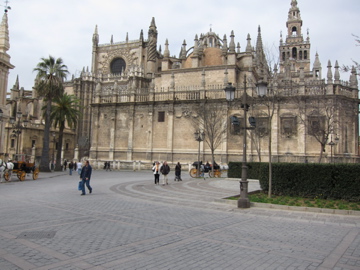
It’s a city famous for its huge bullring (think Carmen), its gypsies (think Carmen), its flamenco (think Carmen), its intense oranges, and its huge over-the-top cathedral, the enormity and seeming haphazardness of which I cannot possibly convey to you by word or photo. In it, Columbus is buried in grandiose style, nothing in this cathedral being less than grandiose. It’s the largest cathedral in Spain and the third largest in the world (after St. Peter’s in the Vatican and St. Paul’s Anglican). Having shown you some of Burgos in a previous posting, you get some idea of how immense this even larger one is: really, really BIG!

By the way, if you haven't seen Bizet's Carmen, go get the opera film. It's one terrific musical-drama. It was the very first live opera I was taken to see (by my parents' friend and  piano teacher who despaired of my ever getting in tune)... and I still love the feistiness of that 'bad' girl heroine. (Bizet wasn't Spanish, so how could he have  known it's "torero", not "toreadore. Then again, I guess in lyrics it's fitting the beat that matters most). 


This is a major altar in the Seville Cathedral... the figures are life-sized or larger, so get an idea of its scale!
Much of the Cathedral is done in the plateresque style (plateresco), which is typically Spanish, and exported to Spain’s colonies in Latin America. Literally translated (plata = silver), it means "in the manner of a silversmith".  It’s  characterized by profuse and lavish applications of delicate low-relief ornament in a variety of motifs, including Gothic, Renaissance, and Moorish design. Gilding and painted surfaces are included in the elaborate ornamentation.

Seeing this style so often in Spanish cathedrals made me wonder if the elaborate excesses often characterizing a Spanish girl’s Quinceañera could derive somehow from this long-standing Spanish tradition for ornamental display. 
Columbus's tomb in Cathedral of Seville (larger than lifesize figures)

I got shell-shocked after walking into the Cathedral. It was too big, too disorganized, too much of too much for me even to get a sense of the awesome or profound or beautiful. Quite the opposite of a rush, I felt a drain. Although I saw some impressive sights in it, as the photos document, I might be the only person in the world not enraptured by this Cathedral and I feel rather sorry about it.
 Here's a fragment of a painting in Seville showing Hell. Why does Hell inspire so much imaginative energy compared to Heaven? the other side of this painting could be a depiction of people waiting patiently for a bus.

My sense of wonder and glee returned after entering the Alcazar Real (Royal Palace), only a brief walk from the Cathedral. The Christian monarchs, Alfonso X and Pedro I employed Moorish craftsmen to build it in the 14th century. It's a wonderful example of  Mudéjar architecture (a mix of Moorish-Western).  


This royal palace, once inhabited by Isabella and Ferdinand, is still inhabited on their visits to Seville by the present Spanish king and queen (Carlos and Sophia). Aside from the royal quarters, much of the Alcazar is open to the public to see its ancient treasures in paintings and architecture (mostly Moorish, again, along with renaissance motifs ). Columbus had one of his latter audiences with Isabell and Ferdie in this place, perhaps both impressed and daunted by what he’d started to roll. 
Mosaic tiles in Alcazar Real, Seville (JS
Moving easily from the sacred to the profane, we went to see a Flamenco performance that same evening. I think I must have gotten hooked on Flamenco when I was an infant and  saw Julio Greco on the Ed Sullivan show. Such restraint in the midst of conveying strong emotion still gets to me. I don’t like bull-fighting; but I do think of the stamping movements in flamenco as embodying something of the bull’s pent-up rage. Similarly, the taught push-and-pull movements of pairs of dancers conveys an energy related to taming, while at the same time expressing, our animal/sexual nature. I’m sure there are dissertations out there on the "meaning” of Flamenco. But I just enjoy it: the music, the singing, the dance. It’s not happy, but there is so much energy and vitality in its pulse.
Today's Thought
Music expresses that which cannot be put into words and that which cannot remain silent.
--Victor Hugo
I found an intriguing bit of information on Flamenco provided by the Frommers’ travel site, from which I’ll excerpt.  They mention connections between flamenco and the tragic fate of Spanish Jewry, suggesting that a Sephardic presence can be felt in flamenco music.  Flamenco took root after the  1492 expulsion and flourished underground. They state that many flamenco melodies are similar to Hebrew prayers, also noting similarities of the Hebrew “jalel” (to encourage) and the flamenco “jaleo” (the hand-clapping and shouts of encouragement accompanying the dance). Even the name flamenco (“Flanders” in Spanish) was how Conversos in Spain referred to the sacred music of their co-religionists who had emigrated to Flanders where freedom of worship was permitted. Who knows?


 I enjoyed staying in Sevilla. The hotel (Hotel Las Casas de la Juderia; photo at left) was a treat as were the small cafes and restaurants. People seem to enjoy living there. The unusual and highly rated hotel we stayed at was converted from a series of old houses  and retained some lovely old qualities along with excellent modern facilites and staff. 


Today's Painting


Cat & Hat, www.janetstrayerart.comhttp://www.janetstrayerart.com

post signature To COMMENT from the homepage: Click on Title of Post to get to its own page. Comment box appears below post. Subscribe for updates on art, travels, and adventures in creative life. You can also find me at my Facebook Page and Website for my art and news of upcoming shows/sales.

Monday, May 23, 2011

BILBAO and BURGOS


We spent a morning in Bilbao and then the afternoon and evening in Burgos. Not that these two places have anything else in common. Bilbao is fiercely Basque whereas Burgos is proudly in Castile and very Spanish. These two cities were as far north in Spain as our travels took us and not too far from each other by car.

Don't you just have to love a place with a name like "Bilbao"? In fact, Bilbao is a distinctly not-charming industrial port city. However, it now boasts one of the most famous structures of the late 20th C: Frank Gehry’s Bilbao Guggenheim Museum. I had to see it.
all photos by JS
And it did not disappoint. If there's any continuing controversy about it, my vote says it's a winner! 
What a terrific, expansive, surprising feeling to come upon it, to walk around and in it. Doing so, I kept being gleefully surprised. It was a totally up feeling for me. And frankly, Frank, I hadn't come with any particular expectations of even liking it. 


I took the first photo (L) on the walkway that sneaks up to the entrance GG from one side. You turn left at the dog and walk slightly down (you'll see). The photo (R) beside it, with the "boat prow" shows the entrance. The metal 'shingles' and the different colors they take in different lights and shadings, the shapes, the ins-and-outs of it... caramba! this is an exquisite piece of work. It has so many different facets that no one rectilinear view does it justice. 

Construction continues in the area around the museum. I'm not sure what the finished result will be as an environs for it. But so far, so good.

I rather liked this photo I took looking up at a suspended crane... part of the construction I mentioned.
Now that’s a puppy! This flower-growing sculpture is some distance in front of the Bilbao Guggenheim, and puppy's looking across the the street.

I just liked Gehry's structure so much that I can hardly remember the paintings it held (maybe that’s not so good). 

One memorable sight was a Richard Stella steel sculpture taking up an entire museum wing. It was just so right in its setting. One could walk inside and through it: walking within a sculpture within a sculpture! 

The current show: Chaos and Civilization (see sign in photo below) was OK but not nearly so stirring for me as was the museum/sculpture  itself.
This museum seems to have done good things for the city, too, attracting many other cultural ventures.  

Bilbao is a busy Basque port. Much political turmoil exists between the Basques/ETA and Spain, and you likely know of the terrorist outbreaks. The Basque Liberation Movement/ETA has recently, after many years of wanting separation, signed an entente with the Central Spanish government.

In this region the Basque language shares space with Spanish in street signs, menus, etc. Basque is a strange language (lots of Ks and Cs and Qs) ... or at least one that  I cannot relate to any other language with which I’m even vaguely familiar. Spain and France both share a history in this region, known as the Basque, which is ethnically, linguistically, culturally and historically unique. 
Today's Thought 
He preaches well that lives well.  -Miguel de Cervantes                                                                                                                                                                                          
From Bilbao we went to Burgos. Quite a contrast. Burgos is one of the oldest and most staid cities of Castilla-Leon. It was the historic capital of Castile. Castilla etymologically is the land of castles, built during the expanding Christian fortification in northern Spain. The people native to Burgos claim  to speak the best Spanish (Castellano actually) in Spain.
Burgos is known also as a stopping place on the pilgrimage route to Santiago. Known also during the Spanish Civil War, it was Franco’s headquarters.

Now Burgos sits sedately beside the river Arlanzon. This was a pleasant place to walk despite the dreary weather (grey and rainy). 

It looks like a thriving city as we walked around it, with evidence of its long-running ancient university in the many bookshops around town (where are all our bookshops in North America?). But I wanted especially to see its main cathedral (there are several in this town), and to get inside.


Burgos Cathedral is one of the oldest and largest in Spain (a country with a castle and two cathedrals at almost very turn, as I've said). It was begun in the early 1200, based somewhat on French cathedrals of the middle ages, its  construction spanning to the 15th century. It's impressive with its massive Gothic style. It seems to me that the Spanish Gothic style prefers more solid and chunky proportions than the more slender versions of Gothic cathedrals elsewhere. It's much too massive to take in with an ordinary camera lens. But wait, it's only the third-largest cathedral in Spain (those in Seville and Toledo are larger.) Its front is flanked by towers terminating in octagonal spires covered with open stonework traceries. The middle section serves as an entrance. 

                                                                                                                                                                         And there are some treasures inside. For example, here's its renowned Golden Staircase you find while walking among the 17 different chapels housed in this interior space. There are many mansions...
In addition to the multitude of sculptures and artworks inhabiting the cathedral, there is a separate section, the Cathedral Museum which contains many tapestries of the 16th and 17th centuries and many works in silver and metal to do with church functions and liturgy.

The Cathedral is exceptionally well organized with signs directing visitors where to proceed. The cathedral also does a good job of educating its visitors in cathedral architecture, artistic styles, and iconography. It was good to be invited into such a cathedral while also being invited to learn something about cathedral styles through the Gothic ages and early Renaissance in Spain. Everything important was labeled. But being somewhat polymorphically perverse, I also enjoyed the things less labeled. 

Below are some photos of the little creatures I like to find, and one of the many "incidental" or unlabeled works that  caught my eye, as well one of about 100 Gothic statues that fill the interior.
Burgos seems a thriving city and I actually liked this famous cathedral.  I admit to getting that “oh-no-not-another-cathedral” feeling after visiting so many huge, gold-filled, elaborate, drippingly ornate structures with their sometimes profoundly unsettling depictions of torture and suffering… not to mention all those Madonna Dolorosas of the palpable tears. I get the point. Give me a nice, life-affirming Madonna and Child any day! 


Dedicated to the Madonna, the Burgos cathedral, despite its size, invited and aided visitors.


The Spanish hero of the Reconquista, the fabled El Cid was born in Burgos and lies buried in the Cathedral, a simple engraved stone marking the spot. Several finely sculpted tombs of other dignitaries lie here as well. May we all rest in peace...  my hope is that we may do it while still on this earth! 


Today's Painting
Woman in White Wimple, painting by Janet Strayer, janetstrayerart.com


post signature To COMMENT from the homepage: Click on Title of Post to get to its own page. Comment box appears below post. Subscribe for updates on art, travels, and adventures in creative life. You can also find me at my Facebook Page and Website for my art and news of upcoming shows/sales.

Sunday, May 15, 2011

Musings about Travel


Today's Painting: "Gotta Go" by Janet Strayer, see janetstrayerart.com 


mutiple canvas mixed-media artwork by Janet Stayer, www.wix.com/janetstrayer/paintings
"I dislike feeling at home when I am abroad", said G.B. Shaw, and I agree with him. Not that home is bad. Not at all. I live in a good spot on the globe. And not that I seek discomfort. No way. This blog is about living creatively WELL, after all. My 'travel-in-the-rough' days are over because I wouldn't be able to enjoy them now as I once did. Besides, "rough" is relative. Although I've travelled on very limited budgets and hitchhiked and backpacked when I felt comfortable-enough doing so, I was never the rugged ragged traveller. And I certainly am not now. Age is not the determinant. 

One of my traveling mentors, a woman some years older than I, has taken a big trip once a year for many years. To this day she loves very challenging travel to exotic and hard-to-reach places. She's hiked Kilimanjaro twice in recent years, re-visited Bhutan, the hills of Vietnam, gone trekking in Africa, and around the world she continues. Last year she sent a photo of  herself in shorts and hiking boots, sitting cross-legged on the ground and being approached by mountain gorillas at the eco-reserve founded by Diane Fossey. She's the most adventurous traveller I know personally and she's managed most of it during her yearly vacations from demanding work. 

In contrast, though I've done some of that kind of traveling, what I like best is to go somewhere that seems interesting to me and stay there a bit, to live there if I can. Sometimes, to make several visits back and see what more I can see. Though less physically active, what I share with my wonderful friend is a sense of adventure, an openness to new experience, a willingness to accommodate to new environments, to assimilate, to learn and enjoy myself in new surrounds.

Today's Thought

I soon realized that no journey carries one far unless, as it extends into the world around us, it goes an equal distance into the world within.  
Lillian Smith, U.S. novelist (Strange Fruit) and social critic

More and more frequently the edges
of me dissolve and I become 
a wish to assimilate the world    
Margaret Atwood poem (More and More)

Today's Painting #2
Child Out of Time: Bubble
In my view, travel as part of a life-adventure isn't and can't be fully comfortable. Travel has to disequilibrate, to shift things around a little both inside and out. Optimal disequilibration is a motivating drive to human development. It's that curious and exciting space between the familiar and the almost but not- quite grasped.  

Like my friend, traveling for me isn't a rest so much as a change. To hazard an improvement on that old saying: sometimes a change is a lot better than a rest. Maybe Seneca had it right again: travel and change of place impart new vigor to the mind.


post signature To COMMENT from the homepage: Click on Title of Post to get to its own page. Comment box appears below post. Subscribe for updates on art, travels, and adventures in creative life. You can also find me at my Facebook Page and Website for my art and news of upcoming shows/sales.