jquery paste

Showing posts with label umbria. Show all posts

Tuesday, June 28, 2016

Go Fly a Kite! in Italy

Summer in the Umbrian Countryside

Summer has suddenly burst through in Umbria, with hot, sunny days after a long spell of thunderstorms, rain, and chill.  Spending my final weeks here in the beautiful Umbrian hills, I'm taking in all I can of my surroundings... while rampant mosquitoes get their fill of me. Reciprocity.

Go Fly a Kite!

poster ad for kite-flying in hills of Umbria, Italy

This was just the kind of unexpected event that kept popping up to rival conventional ideas about what to do in Italy. Especially so because the invitation came from a mature, rather reserved and distinguished  Italian woman. It seemed to me a totally charming and captivating idea. 

Umbria is filled with lush hills everywhere you look. You can usually count on some winds and.... why not? Kite-flying seems a fun thing to do. Plus, we were about to learn something and create our own kite. 

We drove together to the event. We chatted a lot, and she was helping me along with my Spanish-influenced Italian. All the while, I silently noted how competently fast she took the hillside curves. I was still much more tentative with my foreign driving habits on these sharp, high, curves). 

Small Medieval Chapels Throughout Umbria

As we neared our venue, we came to a small, 15th C. chapel. A friend (in the photo) showed me the  semi-restored frescoes lining its walls. As I've said, there is always something remarkable in almost every locale you set foot upon here.
chapel in Toscolano with friend, Anna Giovanni

Go Make a Kite!

After being introduced to the event organizers, we were joined by about 50 other people of all ages  and seated together at  several long tables. We heard and saw slides that accompanied a enjoyable  presentation on  the history of kites and kite-making. In contrast to other presentations I'd attended  in Italy (mostly academic ones that went on for much too long)., this one was brief, interesting, and well illustrated. 

Added to that, the hands-on challenge was to make and decorate kites ourselves! Of course the kids loved it. What a kick for all the adults who'd never thought we'd get to play like this! My rather reserved friend seemed a bit embarrassed by the idea at first, but then got fully into it once the materials were in her hand..Good for her. It made me smile to it see all of us mature people transition into child-like seekers and makers of objects that could fly.

my kite in progress

We were given all the materials and instructions needed, and got to work while the rather wonderful history of kite-making flashed on the large screen. Everyone set to work, everyone looking so earnest in their playful attempts to make a kite that might fly... and decorated in our own way. 

The Kite Runner, a fine novel by Khaled Hosseini that takes place in Afghanistan, came to mind, along with thoughts of the meaning and value of kite-flying in human history. DaVinci and Benjamin Franklin were among the the famous kite-fliers of the world. Kites were made in all cultures of the world, especially featured in China and Japan, but also throughout the mid and far-east, and elsewhere. 

But Will It Fly?

The crucial reality test came next. 

When our kites were finished, with streamers and string attached, we went to a nearby field to test them out for real.  Would they fly? Truthfully, I was anxious about mine. It was my first, and I couldn't remember when I'd last flown a kite anywhere.

A hot sun was beating down on the field. I took off my shoes and tried to run in the grass with my kite held high.  Seeing my lame attempts to get my kite off the ground, a young boy came over and asked if he could fly my kite for me.  Indeed, yes and thank you !  Around and around he ran, delighted. And it so delighted me.
 
and my kite flew...

This Kite Carries a  Message

If there's meaning in kite-flying (of course there is), here's what I make of this experience. It's the importance of play, of exploration, and of seemingly unimportant things. The kindness of friends and new acquaintances sharing in gentle communal activities.  You never know what may fly. 

More Creative Life News

You can read and see more about Italy at Creative Life News here. plus other travels and creative adventures by this itinerant artist at Creative Life News here
 @ janetstrayer.com


l

Friday, April 29, 2016

Artist En Route: Umbria, Italy (earlier version in Art Avenue magazine)

Living in the Umbrian Countryside

It's April as I write from high green hills in the Umbrian countryside, midway between Florence and Rome. We live in Morruzze, a tiny village in which nothing happens. The bells jingle on new lambs in the pasture up the rocky road from our house. Wild boar hide in nearby forests, as do truffles. The bees are out, and the silvery olive trees are growing fuller. The birdsong is absolutely operatic as I walk the 6 km to and from the nearby village, looking for wild asparagus along the way. The views are spectacular coming up through worn paths overlooking rolling green hills and patchwork agrarian plots typical of this region. Walking here each day I'm sure Leonardo developed his sfumato technique from these smoky landscapes that soften edges and blend contrasts. Except for some hard winter months, it's been idyllic. 

 What Shopping Does a Visiting Artist Do?


Art Interest: So much to see. Just stick a pin anywhere and go!

A visiting friend wants to go on the Piero tour (click here). I'm glad to oblige this pilgrimage for a local boy from a nearby Tuscan village. Piero della Francesca is high on my list of Renaissance masters. His sense of serenely sculpted light, of physically solid yet beyond-real forms in space, of emotion perfectly contained yet dramatically expressed, remains remarkable to me. 


You could pick any of your favourite Italian Renaissance masters and plan an interesting tour of Italy just by following the trail of their displayed works. Following the trail of Perugino, for example, will take you to Perugia, home also to delicious chocolates as well as savouring the equally sweet and highly decorative paintings by his associate, Pinturicchio. Like many ancient towns in Italy, there is so much to see and enjoy just by walking around and looking, and often festivals to add to the celebration. 


Nearby in the Cathedral in Orvieto  are the muscular and fascinatingly original Last Judgment frescoes by Signorelli (from whom Michelangelo learned a thing or two). In the other direction there are the lovely painted ceramics in Deruta to take home with you. Go eastward and there's the region of Le Marche, with Crivelli as its local wonder, whose paintings provide an odd mix of Renaissance perspective and Medieval decorativeness. 

The art treasures continue, with fresco-lined chapels by the vigorously emotive Giotto (Padua and Assisi) and the sensitively ethereal FraAngelico (Florence, with some of his most personal work on site, as they were painted in his home, the Convent of San Marco). 

Pick your favorite early to late Renaissance master: it seems they're all here
Where Artwork and Setting Are One 
It's especially impressive is when you see these magnificent artists' creations in the settings for which they were painted. Even Leonardo's crumbling Last Supper retains much of its gravitas in the actual chapel in Milan whose architecture it replicates! 

I especially enjoy scouting for treasures in relatively lesser-known places. But who would want to ignore the big showplaces of art-filled Italy? Rome, where the ancient Colosseum nods to Renaissance feats like the Pantheon and the dome Brunelleschi's derived from it. Then there are the dizzying treasure troves of the Vatican, shown in its museum. And unsurpassed Florence. Art is everywhere in the architecture, statues, fountains, museums and public works of such cities.


Two duomos (cathedrals) that I like especially are some distance apart. The one in Milan is staggering. Coming up from the metro station, it's a filigreed vision in honey-white marble that took nearly six centuries to build. It hardly seems real in its intricacy and apparent weightlessness. The best of it for me (sated by now on church interiors, no matter how magnificent) was walking outdoors on its huge, multi-tiered roof. It was stunning being surprised by gargoyles, fanciful architectural flourishes, statues standing on pillars in the air, and vistas across the city.

In contrast, Orvieto's duomo seems to me more humanly appealing in size, proportion, and narrative flourishes. Sitting outside on stone benches built into buildings lining the piazza, you watch as the sun glints on golden mosaics illuminating biblical narratives and assorted statues on its facade. Inside are the Signorelli frescoes I mentioned and, to top it off, in this piazza is the best gelato I've tasted. 

Surprises and delights abound: just keep your eyes open and venture on!

 Contemporary Art and Tradition

What I've noticed about contemporary art seen throughout my travels is that it seems  much the same everywhere. That is, trends seem global rather than regional, with influences like Twombly, Basquiat, and Richter variations everywhere, especially in abstract painting. I'm particular fond of major if not as well-celebrated modern Italian painters, like Morandi in still life and (my favourite) Burri in uniquely abstract works, have pushed new stylistic boundaries. 

No longer apprenticed to guilds or schools, emerging artists now seem to gravitate towards their preferred international icons. Historically, however, Italian art has shown recognizable regional stylistic variations and "schools". Tradition remains important here where people live with centuries of art history at their doorstep. The great humanistic emphasis of the Italian Renaissance, especially, is a tradition that endures even in contemporary paintings. For example, look how many figurative works are included in Saatchi's online Focus on Italy.  

Old Artists and the Avant Garde

Visiting the Sforza castle (Milan) and seeing Michelangelo's final and compelling Pietá emerge unfinished from stone, I thought about his spending his final decade on earth working, on and off, on this sculpture. I wondered why some master artists turn away from their attained mastery and refinements to produce, in their old age, something apparently more raw, unsettling, dramatically different, and far less popular with their contemporaries -- but seeding the future avant garde. True of Rembrandt, Turner too, and others, this development runs contrary to the too common clichés for old age.
Practical Matters: Art as a Way, Not a B

P   Art is a Way, Not a Brand

Wh    When I left Canada more than a half year ago I thought that, whil  I'd settle my continuing argument with my painterly self to mov  pursue one track instead of many and do what art-marketeers advi  advise: develop a brand. I haven't. Instead, away from the
         marketplace, I've decided this isn't for me.  Not for lack of self-dis    discipline or indeterminacy in directions to take, Instead, I have a genuine preference for working and lear  learning that is broad in scope. I don't think I'm alone in this conflict between way and brand, and many of     you may feel similarly. But I've come to respect this as a stylistic preference in how one chooses to expl  explore, experiment, and bring things together in order to create. Away from the usual influences at hom  home, it seems clearer to find one's own creative direction.

Travel's End and  Journey Onward

Looking back over the art I've seen, and done, and the life I've had here, I hope to have shared some enjoyable and useful facts and personal insights with you, wherever you are en-route. The artwork I've produced while travelling has been plentiful and surprising to me, as fitting into several unpredictable "series" resulting from new ventures into fluid painting and mixed techniques .A practical note to travelling artists is that duties for mailing artworks are often prohibitively high. So stay light, if you can. .    
            
It's been a remarkable journey, with a month remaining before returning home. This way of life has become 'home' now --- travelling from place, setting up one's life anew in each place for awhile, learning the necessary, exploring, making do. Never long enough to lay down roots ... or ruts. The only constant has been one's own sense of continuity and of change throughout this voyage. I haven't finished. I'm not ready to "go home." I want to find a way to take some of this way of living with me, even when returning to all the comforts of home, friends, and family.
                                
This trip has been about lots of things, both external and internal. Learning to do without the familiar, reassessing priorities, decisions, needs, and desires. A bit of a juggle between making and making-do, keeping to a plan or letting the winds decide, moving on or staying safe. Living away from home provides opportunity to re-examine decisions and expectations, to re-align oneself without the supports, stimulation and constraints of family, friends, and the familiar buzz of art shows and fellow-artists wanting to get their work noticed. It's been an opportunity to expand, to break out of molds that need breaking, and move in ways that feel authentic and rewarding, whether or not they are applauded by anyone else. 


 My artwork has taken different directions, depending upon where I've been: inside and out. I've met with local artists, seen shows, visited sites, museums, and galleries in each town. Everywhere I've been I've keenly felt how art, whatever form it takes, is a vital part of living life. How this is personally vital for me is the lesson I'd like to take home with me ...  plus a few gallons of gelato.

I hope, in reading these articles, you've shared in this sense of adventure, each of us being artists-en-route in our lives and in our work.


More Creative Life News

You can read and see more about Italy at Creative Life News here. plus other travels and creative adventures by this itinerant artist at Creative Life News here
 @ janetstrayer.com

Sunday, September 4, 2011

Thoughts of Home

Lady in the Palazzo is a title of a book set in Umbria that I purposely did not finish when I lived there. Already knowing that I would miss our life in Umbria upon returning to Vancouver, I kept the unfinished book with me. I continue to read it now …. very slowly. I may write more about this fine gift of a book after my thoughts have settled.  

Living in Umbria was as close to home as I ever feel, anywhere. That is, anywhere you don’t really have a childhood history or share a native language. Still, I felt at home there: like a place in my heart settling into what it recognizes as home.

Today’s Thought
…life is a crafted thing, not a  willed one.
Marlena de Blasi, author of Lady in the Palazzo.

For some of us, being at home may belong to a number of select places, not one. Places you choose or that choose you. Certainly, in my case, it’s not the place of my birth. Home for me is New York City, Vancouver, San Miguel de Allende, and now rural Umbria. Not home in the factual sense of houses or flats, but home as in feelings of abiding connection with something that lives in you even when you no longer live in it. 

If home is where the heart is, perhaps then it is only the expansiveness and dedication of one's heart that defines home/s. 

After my first journey (the first sea voyage to America), over which I had not the slightest control, I’ve come to relish intentional trips of discovery (and work) in foreign places: Cuba, Guatemala, Trinidad, Belize, Costa Rica, a year in South America, four months in Singapore and Malaysia, more time-limited visits to New Zealand, Bali, Burma, Israel, Greece, Crete, Turkey, Tunisia, Morrocco, Norway, Sweden, Denmark, Netherlands, Belgium, Austria, Hungary, Switzerland, Poland, Romania, many visits to Mexico for months at a time, and several months at a time in France, Spain, and Italy. Never yet to China, Japan, Russia, India, central and south Africa. It’s a finite contest between the  pull of places you’ve been versus the temptation of entirely new places.  

Not surprisingly, so many of my paintings done this past year in Europe have themes of journey and travel in them.

Today’s Painting
Ariadne's Compass, painting by Janet Strayer

It’s not my intention to trot the globe with my footsteps, though I’m not averse to that either, if I can manage it. Perhaps I have an errant (but fortunate) gene that makes me wander, looking for home in all the right places, to alter a phrase. Perhaps it’s because I’m an immigrant, first as a toddler from Germany to the US; then as a young adult to Canada. Perhaps it’s because I am home, like a turtle carrying home with me, looking for interesting places to discover and put myself into as a new ingredient: the semi-permeable ‘self’ that happens when you allow yourself to be an interested stranger in interesting places.

The turtle remined me of a painting (below) that I made several years ago in Vancouver. I don’t really know what it “means” but I can make up a story, as can you. For me, it has something to do with a sea-surrounded muse, a remnant of land (a branch) drifting in the air beside her, an obdurate sea turtle at her service, a mischievously bemusing snake that cannot resist chattering to her from its home in a glass bottle, the inevitable winged creatures that find their way into many of my paintings, and an egg for the who-knows-what future.

Fathomless, patinting by Janet Strayer
I expect that one can travel great distances in an armchair as well as via an airplane. But there is, in the actual physical encounter with new geographies, people and animals, the distinctness one usually cannot just imagine, but needs also to remember. All those remarkable aromas, climates, vistas, foods, customs, faces, gestures: tangibles and intangibles that you sense and learn (frustration and discomfort sometimes being part of this). You may come to understand a little more, appreciate a little more. Imagination and memory build upon these experiences, but can’t alone create them.

Then, you miss them. So it is that travel begets travel.

post signature To COMMENT from the homepage: Click on Title of Post to get to its own page. Comment box appears below post. Subscribe for updates on art, travels, and adventures in creative life. You can also find me at my Facebook Page and Website for my art and news of upcoming shows/sales.

Saturday, July 9, 2011

Morruzze: a little Italian village in which nothing happens

all photos by JS
Last night was a beautiful night. We spent it sitting on the stone porch looking out at the sky, its half-moon and stars steadily brightening as the hour approached 10 pm. It was cool at this hour, but the stones still held warmth from the full day’s sunshine. 

The geckos had retired. We’d just finished some deliciously cool and sweet watermelon, its taste mixing with the pleasures of the darkening night with its brightening, star-lit sky. A distant owl was hooting, and the lovely daily birdsong had long been put to rest.  

one of our gecko families on the porch
And then, like sprinkles on ice-cream, fireflies (lucciole) came out, flickering illuminated bits of sparkle upon the night. 

It was peaceful, fragrant, and lovely.  Time out and being in. How few are such moments in most of our life-management styles of living. 


Today’s Thought
Many a night I saw the Pleiads, rising thro' the mellow shade
Glitter like a swarm of fireflies tangled in a silver braid.

-- Alfred Lord Tennyson

My fancies are fireflies
Specks of living light twinkling in the dark.

-- Rabindranath Tagore


The stone country house, to which we returned after an absence of six years, has been our home for the past several months in Italy. You've seen pictures of it in my previous posts. It's like so many in this region, which mandates that homes be kept to a certain,very agreeable, style. It's really beautiful to see the different harmonies of simple shapes and colors in the stonework. 
Soon we’ll be leaving this house we've just lived in once again, returning to Canada after a remarkable nine months in Europe. 

Morruzze in early April

Why live in this tiny village commune of Morruzze in Umbria? 

I’ve written and shown pictures of this place in previous posts. So I’ll now show you one of the first things I found on the internet when searching   “Morruzze” (from MBendi information services)
 
Isn’t it impressive? In each category, it lists absolutely Nothing! Actually, as you know if you’ve been looking in this blog, there’s much here. Lots of life, including the human social variety. Local notices are always changing on the large notice board behind the well  in the Piazza Cesare Paparini. And, there’s even a fine little guest house to rent adjoining the Palazzo Paparini (click to see). You can see website photos of this charming place, but below I want to show a rather bare but, I think, striking photo of an unrenovated part of the palace we routinely walk by.


We arrived here in Morruzze when everything was some shade of green. The different wild and cultivated flowers added their particular shapes and colors throughout the spring. 


As the summer approached, we saw the green casting more yellow and tan as fields were mowed and hay was baled.

 
And now, full summer, the girasole/sunflowers are out in full regalia performing sun salutions. It remains a simple joy to me to see whole fields of girasole turn their faces to the sun, wherever it may be, bowing slightly at the end of day. Despite my factually-competent brain, it’s easy when observing girasole to imagine a plant-consciousness that adores the sun.


Of course, I will have to paint some variation of this!
What continues to impress me most here is the quality of the region, itself. The clean air, the sounds, the fragrance, the colors, the living and growing things all around, the pace, the openness, the welcomeness, the variety of small and great things to walk amongst. Not much, ... but nearly everything.

I want to tell you more, about nearby Todi and Orvieto, about many the other local sights we’ve seen, and to share with you more wonders. But we leave soon for Verona, city of Romeo and Juliet. We have tickets for an open-air  performance of Aida at their beautifully intact Coliseum. From there, we drive to Paris, and from there…. ah, we take the metal bird home.
There is so much more. But can I catch up with myself? Will these postings feel different when I write them from afar, instead of amidst these sights? Will I write at all of here once no longer here?

For now, perhaps goodbye, perhaps arrivederci
Thank you.


post signature To COMMENT from the homepage: Click on Title of Post to get to its own page. Comment box appears below post. Subscribe for updates on art, travels, and adventures in creative life. You can also find me at my Facebook Page and Website for my art and news of upcoming shows/sales.

Monday, July 4, 2011

Life With Animals in Rural Italy

Life with Animals

Living in rural Umbria for some months has been a great experience. So much art and cultural history, as well as all the natural scenic wonder.  But I want to give the animals here some credit too. I rarely write about animals, but they've been important companions to my life here, especially on my walks along these hilly country roads. 

The best things in life aren't things.--Art Buchwald

I'm a city girl and claim no affinity with Jane of Tarzan fame. Furthermore, this is no jungle. But, living in this fairly secluded rural area has brought me much closer to animals on a daily basis. Nothing special, you may think. But it has been special for me. The birds and animals have become part of what makes this place come alive for me. 

Birds and Fowl  

First off, there have been the songbirds in the morning that brighten the day. I hardly see them, but love hearing them daily. If I don't hear them, I know something is up. like an upcoming storm or too many hunters in the area. There stillness tells me so.

photos of chaffinch bird and nearby rooster
chaffinch and rooster

There are the chickens, geese, and even turkeys that inhabit the several fenced yards along my country walks. Some creatures show up walking freely about, just as I am. The two chickens below were taking their walk on the grassy verge across from mine. On my way home, this rather fancy pheasant stopped for a snapshot in front of our patio. 

partridge  in front of patio in Umbria
pheasant in front of our patior-

Four-Legged Friends and Foe


A short distance from the house are meadows abundant with grazing sheep. Spring is a prime time for viewing the new lambs. A lovely pastoral sight that is  also functional, given this region's renowned lamb dishes. Other meadows are grounds for grazing goat, but they tend to rebuff my human approach. 

 Then, there are the geckos that live  in and on the patio rocks, darting fast as a flicker across them. Sometimes they venture inside the house. I once found one gaily swimming in the kitchen sink and,  quickly as I could,  moved it outside where it scurried off. Sitting on the patio, I enjoy watching them as they dart in and out among the the pots of cacti and geranium. Some are a very bright, iridescent lime-green colour. Others are striped with dark diamond shapes. Not only are they very quick, they also seem shy. But, if I sit quietly at the patio table,  I can see them stretching  their necks and looking about, seemingly unaware of this big hulk of shade who's blinking her eyes while she looks at them curiously.

There are many dogs, of course. Everyone has at least one. They used to bark as I passed, but now most of them know me. Mostly I love the dogs here. They’re so…. Italian, with names like Cuciolo or Pipo. If I don't know their real name, I give them one. I call the little orange scruffy one up the road Scruffy, and his more silent companion is Harpo. Then there’s the beautiful white dog further on, whom I call Lily (though she’s male). In contrast to these family dogs, the hunting dogs here  are another story. I don’t see them as often as I hear them yowling during hunting season. They don’t just bark; they yelp and moan and bay, and I imagine them caged when not on the hunt, hungry, and possibly mistreated. The law in rural areas, such as this, is that hunters have right-of-way during the season, so they, their dogs, and rifles are permitted on private"land. A whole mess of spent cartridges can be found after hunting season.

There are many cats as well as dogs. Most here are well-tended, unlike the hundreds of  sorry-looking cats I saw hanging out in Rome’s Coliseum. Cats are particularly useful for homes here, given their rodent-hunting skills., and who does't like watching them move always in  their own graceful stride? 


In it's own category of special animal is the porcupine. Have you ever seen a live one? One night, on the path beside our house, I saw two porcupines in full regalia! They were right in the headlights of our car as we very slowly drove down our unlit, rocky path. I wish I'd had a camera with me. They were terrific-looking animals, much larger than a skunk, and had their quills splayed out.  The two porcupines dashed quickly out of sight, making what sounded to me like hi-pitched rasping-chirping  sounds. I'm glad to have seen them and to have done them no harm. I found some of their quills on the road next day. They are horizontally striped ivory and brown, and I'm going to keep them. 

porcupine quills
 I've learned is that the porcupine (porcospino in Italian) doesn't shoot its quills, contrary to folklore. Having few natural enemies, other than humans, it flees rather than fights. But it can bite, claw and even charge backwards, using its quills simultaneously as weapon and shield. Considered solitary nocturnal creatures, adults live in pairs with their litter. They're protected by Italian law and don't have to pay taxes.


One of the most famous and dangerous animals of this region is the wild boar, or cinghiale. They live  in the woods all around us. You can hear (or imagine you hear) them tearing up the ground at night. During the day, you can certainly see evidence of their digging up roots and rocks. Big overturned rocks are all along the path from our house all the way  up to town: signs of their up-rooting activities. You can see the damage they wreak on land, trees;, and even the prominent stone fences of this region. They do hunt down truffles, though, and they're also a source of good sausages in this region. The photo at left (taken before the earthquake) is a boar-replica from Norcia, a town famous for its sausages. To the right is a photo of an actual cinghiale.  

,


Introducing Balthazar

Several times, I heard a donkey braying as I walked down paths from the piazza in our village  of Morruzze towards the next village of Acqualoreto. I'd never seen him until one day when it began to rain  as I trekked back home alone. I felt rather miserable and the path seemed much too long. I heard his braying get louder and louder as I made my way up it. . After turning at a bend in the road, there he was, sticking his neck over the wire fence lining the trees and and bobbing his head up and down as if saying, hi there, you made it!
my Balthazar

I walked over, never having made the acquaintance of a donkey before (though I have met some asses). Seeing a stack of hay under wraps on my side of the wooden fence, I grabbed a handful and held it up to him. He lipped it up from my hand very gently, given those big donkey-teeth. It was raining more strongly now. So, I  told him I couldn’t hang around to feed him and had to walk up uphill if he wanted to keep me company. 

Don’t laugh! He did, and he followed me all along the path until I reached near the piazza, where  our roads diverged. He brayed as we lost sight of each other, and I knew he was a friend. I named him Balthasar, after a donkey made famous by Bresson in French cinema (Au Hasard Balthazar). Like his namesake, I think my Balthazar must have a good deal of empathy.

Snakes and Scorpions

Among the few other animals here that can be dangerous to humans (including some of the two-legged hunters!) are some snakes, including vipers and asps that are hard to see in the tall grasses. My neighbour told me of once having been bitten by a viper, her leg swelling with great pain. Her advice was to wear thick rubber boots, as she does in the tall grass.  Otherwise, I think the snakes want to avoid us, too. We don’t have much to talk about.


 I’ve also seen  scorpions here. and in the house, unfortunately. These tended to be small, (less than two inches long). But who wants to test out just how much harm a small one can do? So I never put my slippers on without shaking them out first, just in case. Like other insects, they are rather fascinating to look at: their shape is so unusual, making me think of them as more aquatic than terrestrial.


Food for Thought: Truffles


Umbria is rich in truffles, as its many cinghiali know. Locals debate whether white or black truffles are better. Aren’t these debaters fortunate to even choose? If you find yourself in possession of a truffle, bow down to it, then store it in rice for a few days, as the Italians do (not the 'bowing down' part). Its aroma will permeate the rice, giving you double value. They say to cook black truffles, but eat white truffles raw (exquisite shaved thinly over pasta).There are truffle festivals in Italy, mostly in the fall (truffle season). Click here to read more.

More Creative Life News


You can read and see more about Italy at Creative Life News here. plus other travels and creative adventures by this itinerant artist at Creative Life News here
 @ janetstrayer.com


Tuesday, May 3, 2011

Wild Asparagus Hunting in Umbria

Eating What Grows Wild

I'm city-bred and nearly all the food I ate came from grocery stores. Until I started travelling,  I'd never eaten food taken directly from the earth with my own hands. These days, we have a pretty large vegetable patch and fruit trees on Saturna Island in Canada.  

But it took living in Italy, and walks with a lovely friend who'd spent a lifetime living in Italy,  to introduce me to a walk and eat on the wild side (thank you Anna Giannini). This elegant lady has an appreciation for the countryside and its treasures. And is much more agile than me when climbing slopes, jumping crevices, or balancing on wooden fences we weren't supposed to be on.. all this to reach just the right spot for the wild treasure.    

I've written about the chestnut groves in Umbria  (getting lost in them), and nearly everyone here has their own olive grove (the oil that is pressed communally is wonderful). Many have their own gardens because they prefer eating what is fresh and in season. They know how to pick the best of each variety of product in outdoor markets, too, going to one stall for a particular lettuce and will march a street length to a different stall for its fennel. Truffle  grow almost like mushrooms n this region of wild boars. Picking out different varieties of  truffles is a well-practiced skill  that defies me, so I make do with  the recommended truffle-oil. 

But the real treasure-hunt is in the wilds near fields and beside the roads. I wasn't bad at spotting wild berries (a familiar pastime in summers at home). Here, y friend introduced me to berry I'd not seen before.  I could recognize the wild blueberries on bushes, but these berries, called corbezzoli,  were  new to me. They look exotic, but seem to grow everywhere here. Their texture and taste is a bit  like a strawberry (and they are related). Their cute shape and vivid colours make me want to hang them out for parties. 


The key venture , though, remained the hunt for the wild asparagus. 

How and Where  to Look When Asparagus-Hunting 

Pick sunny day to go asparagus-hunting and look along the road verges for wispy slim fronds that poke out a bit like rosemary.  It took me awhile to catch on to how to stalk them (punny, yes). 

The trick to finding these reticent delicacies is to look for the silver-green, unkempt, and straggly fern-like bushes that tangle around other plants.   The more brightly green little asparagi (who says that?) grow among this chaos of green. But once seen, you've got a good idea of what to look for. As you reach in for the picking, they tend to scratch your hand to confirm they've been caught. 

They grown hidden among the ordinary dense green growth of bushes, ferns, and vines of this region. Hardly visible in the photo below, those are the spindly, feathery stalks that asparagus  grow on.  Trouble is, those spindly, feathery  stalks look much  like others that are not the asparagus variety,. It takes time and practice, I guess. 

When you find them, though, they are much more fragrant and intensely flavoured than the thicker and more anemic store-bought kind. So good. 

photo of wild asparagus growing in Umbria

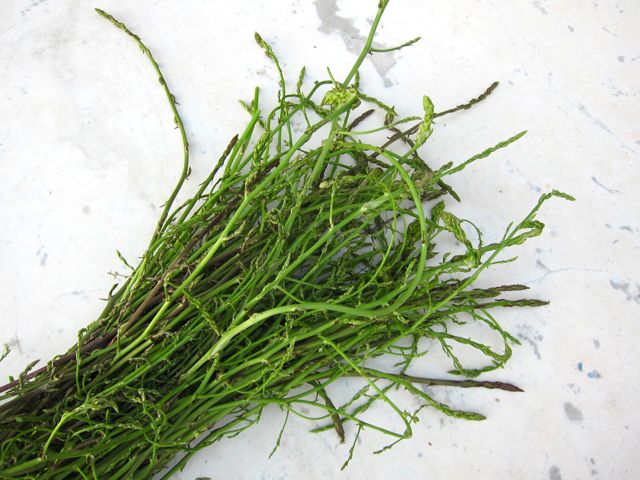
Here's what a collection wild asparagus looks like, taken from a site with a great frittata recipe for them (click here). 

Nothing Gets Taken for Granted

Asparagus hunting was the goal of this expedition. Frankly, though, anything would have been  a good-enough reason on a bright day in rural Umbria.. It's really glorious: the temperature is just right for walking, the sky is filled with light and just enough cloud to make it interesting. And of course the birds are in full voice. I don't know much about birds, so it surprises me that they sing even at night here.

As I walk along the paths, it js  easy to imagine what prompted St. Francis to talk to the birds. And  how clearly the birds must have talked to him. The birds really do seem to call out to me when I'm out walking here. Some whistle like a friend down the road might do to get your attention. Others sound sharper, like New Yorkers I remember calling a cab. Others seem to flirt or tease. Others just sing bits of melodies,  chirp, trill, warble, or even stutter their message. They don't seem to mind sharing the countryside with you. And all the many cuckoos around here form a  persistent chorus! I've unofficially named our little rock-strewn road, la Via dei Cucoli , in their honour.

I was thinking that everything here seems so well placed, so settled in, giving a very satisfying impression of itself. Even the apparently anarchic asparagus bushes seen to be just where they should, once you find them. No wonder, really, given that this land has been grazed and tilled, and grown for centuries. Still, the land itself, especially when seen from a distance, looks so casual but finely laid out As if nature itself is guided by the Italian notion of  fare una bella figura.  

Yet this high Umbrian land is not at all an easy place for cultivating crops,  given all the rocks in the soil. Even today, much work still needs to be done manually. People work hard here in . And the rocks keep piling up year after year, as if the earth grows rocks as fast as it grows vegetables. Still, there is (for me) a grace to this countryside: the peace, the simplicity (not the ease) of life here, the i invitation to roam slowly about , the seasonal changes,  and varieties of natural sounds. I know it isn't always idyllic in the countryside. But leave me to my moment here... and share it.

More Creative Life News

You can read and see more about Italy at Creative Life News here. plus other travels and creative adventures by this itinerant artist at Creative Life News here


.