jquery paste

Showing posts with label art. Show all posts

Tuesday, February 20, 2018

Otranto in Puglia and its Marvelous Mosaics

Otranto in Puglia:A Real Find!

I love this place!
Otranto is a another exceptional place well worth a visit on this narrow heel of southern  Italy. We went there primarily to see its noted medieval mosaics, one of the largest pieces of inventive design to survive intact to our day. These mosaics also contribute one of the most important pieces of artwork  
from the middle ages.

It's a wonder to be able to walk among these images today. They remain vibrant and so interestingly unique in their depiction of familiar themes.

 
A man on branch of Tree of Life, Otranto (Janet Strayer photo)

Built by the Normans in the 12th Century


exterior entrance, Otranto Cathedral (Janet Strayer photo)

The mosaics are the highlight of Otranto's ancient cathedral, built of monolithic granite and marble by the Normans at the beginning of the 11th century and incorporating Romanesque, Byzantine and early Christian styles. Despite the flourishes added later, the simplicity of its architecture and its stone rose-window may seem like a relief after all the very ornate and elaborate Baroque one sees in later and larger cathedrals. But just wait until you step inside! It is fantastic.

An Artist Who Did Not Want Anonymity


photo credit

One artist, a monk named Pantaleone (with his co-workers), was responsible for all this mosaic magic. He must have been sure enough of its legacy to leave his name in stone, along with all the other Latin inscriptions. Ah, the ego of an artiste!


nave mosaics, Otranto, photo credits

These wonderful 12th century mosaics are very different from the justly famous gorgeous floors and walls seen at Piazza Armerina in Sicily. First of all, here you are actually walking on the mosaics (for better or worse, in terms of their conservation). The mosaic floor is part of a still  active church, with pews set atop them. Wonderful for the parishioners, I'd think, but a bit disappointing for viewers from afar who have read about this marvellous floor and wish to see it uninterrupted and undamaged. For photos taken with the floor cleared of pews, click on this recommended link. Otherwise, here are my own photos, taken under the present conditions.

Elephants holding up the Tree of Life (sideways view, Janet Strayer photo)

In the center , as you enter the cathedral, you see the Tree of Life balanced on the backs of two elephants. The tree branches out into the aisles and apses and beyond. Other original depictions range from genesis to redemption, all created  with what seems to me a joyously inventive spirit and accomplished within a fine overall sense of decorative design.

Walking On an Illuminated Manuscript

The floor is so compelling, you might forget to look up at the elaborate carved and decorated ceiling, a contrast to the more simple architectural pillars and layout.
interior, and ceiling Otranto cathedral, Janet Strayer photos


But look to the floor! It's like walking through a huge, illuminated manuscript of the time. You even see some aspects of life (clothing, agriculture) in the Middle ages. Everything links to     everything else in this marvellous depiction of the ever-branching Tree of Life!

Not just Old Testament (Cain and Abel, Jonah and whale, Sampson and lion , etc.) and New Testament theological narratives are depicted, but also the zodiac, pagan references (satyrs, etc.), fanciful beasts and mythological figures and symbols, as well medieval romances.


depictions of the Zodiac, and other fantastic creatures (above) photos by Janet Strayer

The inclusiveness expressed within Otranto Cathedral  is said to mirror the interests of a once international city (of Catholics, Greek Orthodox, Jews and Muslims) in which "the culture of inclusion" thrived. Otranto was a hub of maritime trade connecting cultures of East and West. One hopes this focus on inclusiveness instead of insularity still lives on. 

More Creative Life News

You can read and see more about Italy plus other travels and creative adventures by this itinerant artist at Creative Life News here.


Monday, October 31, 2011

My Magical Island: Saturna


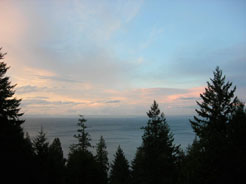
I live on a magical island that’s only about 12 square miles (31 sq. km). in size and that sits quietly in the Salish (pronounced Say-lish) Sea. There are only about 300 other people living on this small island called Saturna.
    
on a bluff, looking out to sea, JS photos


sunset on Saturna, our place up above the sea


Mt. Baker in the US seen from Saturna Island Canada, JS photos


As if its location weren't special enough, Saturna has some exceptional petroglyphs as well, some on high and others only visible at low tides by climbing over and through slippery rocks and small caverns in the shoreline rocks.

Petroglypths on Saturna...these photos are older, now many are even more eroded..JS
My Magical Island.
Saturna seems a good place for wishing, the imagination having free reign without the impedances of city life. I wish Shakespeare, that word-magician could visit here. He'd swoon at the sounds and sights, and even the name of the place, he who so well knew the worth of names: love and rivalry in the sun-lit, star-crossed Verona of Romeo and Juliet; mystery and magic in Prospero's watery realm. But, then again, I doubt he was much of a traveller outside his own world-filled mind.

We have no TV on Saturna and don't even think of it. Instead, we walk around, tend the land, do our work, and  read. I  think of Shakespeare visiting my magical island and being pleased at its comeliness, its seasonal shifts, its rocky shores and tidal pools, invitations to explore and to contemplate. 

JS photo
This is a waterworld, and waterworldness is a quality the island and inhabitants sink deeper into each autumn as the summer falls into the sea. Mists rise to soften the abundance of ever-green trees, and the air is moist with scents of leaves and earth. 

The heavy rains will come, and the ground will fill each footprint with a water rim, reminding us we live upon the sea. Like Prospero’s, ours is a house built close within the elements of wind, earth, and water. Human footprints here tend to leave only watery traces.

I will need to catch some new photos of this water-magic, but these are recent photos I took of some glorious non-raining Autumn days here, to give you a feel for the wonder of the season here. 


I call this the glory tree when it bursts into full colour, JS


It's s autumn now, one of my favourite seasons. It's not as brilliant here as the season can be in the eastern part of this continent, given its abundance of deciduous trees and turning leaves. But here, in evergreen land, the contrast of the turning leaves amongst the backdrop of resonantly rich greens and browns is quite special. We've planted maples and oaks and other deciduous trees on our wild land to take full advantage of this contrast.


And here's our land in the early Spring, with fields of golden daffodils and a budding tree. We've planted thousands of these harbingers of sun over the years.
path to my studio in Springtime, JS


I have been back in Canada, on this West Coast edge of the sea, for more than three months now, and I feel the changes from the sun-drenched Italian countryside where we’d been living. So many different forms of beauty to appreciate. 


Though we've stopped travelling, the mind still wanders like quicksilver, no time or space barriers. So that, here I am in the foggy mists of the Salish Sea and, in a second, I'm back thinking of Verona, our last stop in our Italian trip. 

my studio this Autumn, JS
Perhaps when the rain becomes too dense here, I'll write a post recalling our good time in sunny Verona. I'll think back to sitting inside its ancient outdoor coliseum, watching a stunning performance of Verdi's Aida after an afternoon wandering around the props for this Egyptian-set opera sitting right on the streets of an already enchanting Italian location for star-crossed lovers! That's my kind of geo-mythical travelling!


Don't expect chronology to be too clock-bound here. It's more psychological. All things existing get called forth as needed. Quite Prospero-like, don't you think? 


In the meantime, though, I'm quite content to be just where I am. 

Today’s Thought
We are such stuff
As dreams are made on; and our little life
Is rounded with a sleep.
--Shakespeare, spoken by Prospero, The Tempest Act 4, scene 1, 148–158
A related thought: Graham Swift’s book, Waterland, is a wonderfully literate and emotionally rich book. It’s set in the wetlands of England and relates shifting lives through time, replete with well-drawn characters in a compelling environmental history. Not to be confused with the completely different and forgettable Waterworld.  Although Graham Swift won a Booker Prize for another of his books, this one remains my favourite. 


Seasons of life. Not an original thought, but worth appreciating, nevertheless. Autumn, suggesting a more sober, less lush time than Spring, has its  bursts of glory, too. And, how's this (see photos) for "lushness" amidst the ferns and mosses (instead of among the flowers):

Today's Art
As befits the sea life around the island, and the petroglyph shown above, today's item is a 3D mixed media work on a piece of wood cut in the shape of a salmon. I donated it for an art auction on the island to raise money for local events. Along with other artists' interpretations, it quickly sold. It was great fun to make with paint and colored glass beads.


mixed media 3D art by Janet Strayer


post signature To COMMENT from the homepage: Click on Title of Post to get to its own page. Comment box appears below post. Subscribe for updates on art, travels, and adventures in creative life. You can also find me at my Facebook Page and Website for my art and news of upcoming shows/sales.


Tuesday, June 14, 2011

URBINO: A Perfect Renaissance City Invents "Being Cool"

      After days of rain in Le Marche, I was getting soggy.  No walking outdoors without a drench. 
      So we decided to head out for a 2.5 hr. drive from our resting place to Urbino. It’s this long a drive        only because no route is direct: first you go south towards the Adriatic shore, then up north again.

     The Duke's Nose

       I  wanted to visit Urbino mostly because it’s home to one of the most famous noses in all of art               history: the nose belonging to the Duke of Urbino, Federico III of Montefeltro.

     The Duke of Montefeltro, painted by the master, Piero della Francesco, is always recognizable.               Who could forget that face? 

     Federico III da Montefeltro, of the famous nose, was a highly successful condottiere (mercenary 
     soldier captain). Condottieri were the leaders of professional military companies contracted by 
     the Italian city-states and the Papacy from the late Middle Ages and throughout the Renaissance.           The Pope himself made Federico Duke of Urbino, the area then being part of the Papal States.

     Urbane Urbino: The Ducal Palace  

Ducal Palace Courtyard, Urbino

    This impressive palace was "the" place to be invited during the Renaissance. Federico had a                    fabulous court and invited many illustrious people to it.The Ducal palace and the legacy of                     Federico’s famous court were further developed by his son Guidobaldo, who married Elisabetta             Gonzaga, daughter of the ruler of  Mantua, another small but famous Italian court known for its             excellence in both music and the visual arts. Under them, the court at Urbino further increased its         cultural clout and patronage. It's because of folks like them, and their rich patronage,  that we 
     have masterpiece portraits of secular figures recurring throughout the Renaissance.

A visit to Ducal Palace is a pleasure. It’s arcaded internal courtyard is a center of calm. A masterpiece of proportion and light, it was the first of its kind in Italy, then copied in countless other Renaissance palaces Inside, the stately harmony of well-constructed space continues. But the palace is more barren than I expected (hey, no one lives there anymore). It still houses a fine assortment of paintings, now mounted on free-standing easels near the walls rather than where they would have been seen. It's now clearly a museum (Galleria Nazionale delle Marche). 

The Grand Stairway of the Palace  (described by Vasari as the most beautiful of its time) has very wide and easily rising steps, with inset stone banisters for support. The proportions of each of the open palace rooms are impressive but not intimidating. The inside of the palace is pretty bare, as I’ve said, and the walls whitewashed as a museum for some of the finest art pieces collected by the Duke.

Some original decorations of the Palace remain as they were, including its magnificent fireplaces and stucco-decorated ceilings. Duke Federico's studiolo is a magnificent little room decorated with portraits of philosophers and with with trompe l'oeil woodwork intarsia. Many examples of amazing intarsia are found in doors of the palace. Much of the decorative relief around fireplaces and ceilings depicts exploding grenades, one of the first Duke’s favourite military attack techniques.


The Renaissance Paintings

I was a bit  peeved that some works I most wanted to see were temporarily removed, including some by Piero della Francesca. But I did get to see  his work, La Citta Ideal, a somewhat surrealistic work showing buildings in perspective with open doors but no people. And there was Rafael’s haunting portrait of that melancholy lovely woman called La Muta. And some surprises: I found a small religious work I liked and had never seen: very touchingly done by Giovanni Santi, Rafael’s lesser known artistic father. 

Urbino was  home to Rafael, who grew up amidst the Duke’s wonderful court. His lesser-known father was an admired poet and court painter of religious themes during Federico’s reign. But it was  Rafael who would hit the one-name-only status of instantly recognizable celebrity. Even though he was orphaned at age 11, growing up in this urbane environment gave Raphael the excellent manners and social skills stressed by Vasari as inherent in the Renaissance artist.

    The Invention of "Cool"

       This was the place to be in the high renaissance. Most of those invited to the Ducal Palace had       
       already made it in terms of the reigning standard of celebrity. You had to keep up and hold your 
       own in a company of scholars, artists, poets, nobles and courtier-politicos of the time --  all of               whom (in contrast to our own populist celebrity mania) were expected to have educated minds 
       and  not merely strident opinions.

    This was also a moment in history when being an Artist was elevated to an exalted status in the             social  hierarchy., so long as he (most likely) adhered to the model of humanistic refinement. It was     a time of great strides in Western  scholarship: in mathematics and science as well as investigations        of  ancient writings. There were great bursts in contemporary literary, visual, and musical arts.      

     As well, there was a style of conducting oneself, the art of social conduct and conversation.                      Innovation was encouraged, but no grunge need apply. The model of "casual elegance" or "cooly         knowledgeable" reigned.  The Italian word for it was "sprezzatura". 

    Urbino’s courtly life was to become set for centuries as the model of Italian humanist virtues. This         was largely due to a tell-all book by one of the guests at the Duke's Palace: Baldassare Castiglione's      The Book of the Courtier (1528).  

     Castiglione’s The Book of the Courtier became required reading for centuries for all who aspired           to a  life of power. Many of those same people would also have exchanged succulent bits of gossip        as they shared wines and foods worth imagining. How better to promote court intrigues for                  those versed in the writings of Castiglione’s more notorious contemporary, Machiavelli?

   Sprezzatura

    If it's too evident, it's not sprezzatura.  It’s a style that results from a well-educated background 
    and a well-practiced sociability. It refers to something like an artful spontaneity or nonchalance            in appearance and knowledge: an apparently effortless mastery and naturalness at the same time.            The  trick is that, IF it's visible, it turns into its dreadful opposite: affectation.  

    The term was coined by Castiglione, who advises: avoid affectation in every way possible . . .   
    and … practice in all things a certain Sprezzatura [nonchalance], so as to conceal all art and               make whatever is done or said appear to be without effort and almost without any thought about it."

     This concept, has been around the block. Cicero recommended a studied nonchalance as one style 
    of oration and rhetorical persuasion.  It also appears, I think, in these quotes across nations 
    It takes a great deal of experience to become natural.
    --Willa Cather
    A good style should show no sign of effort. What is written should seem a happy accident.

     -- W. Somerset Maugham  
                                                 
    For me, some the best written examples of it occur in the essays and lectures of that engaging                American, Mark Twain. Or in the style of an Arthur Ashe playing tennis in contrast to, say, a Jimmy     Connors. 

       Food for Thought: A Renaissance Menu 

    This is a meal to last the entire night and perhaps into the dawn. An evening not only rich                         conversation, but one enriched also by music and poetry. And the food! Remember, tomatoes, corn,       and potatoes were New World staples that hadn’t yet made it big in Europe. But garden produce like     cabbage, fava beans, peas, chick peas, squash, cauliflower, cabbage elderberry, fennel, eggplants             would have been likely ingredients.

    This is a privileged banquet, let’s remember, not common fare. So the spectacle of presentation is as     important as the substance offered. Dishes had to please the eye as well as the palate. Not only soup     to nuts, but several different seasonal varieties of dish comprised each course. Exotic innovations as     well as regionally fresh ingredients made this a renaissance feast. Spices, herbs, and olive oil would     be used to flavor and cream, cheese and other sauces would be used to the chef’s skill to enhance, not     to cover, the main food used. A telling point in how expensive the meal was in how fresh the                 ingredients had to be (only the rich could afford to use the freshest meat and sauces made of cheese 
    or egg that might soon go bad).

    Trays of candied fruit and aperitif wines might be brought in as the guests waited to be seated. The         rich soups, both sweet and savoury, were served. Sugar was used as a seasoning for main dishes as         well as desserts.Clear broths might be served as well, to cleanse one’s taste or prepare for the next         dish. Pastas would have been served, of course in all their many varieties -- and you can’t know how      many until you travel around Italy! But not in tomato sauces until this New World import became         more evident in European markets. An assortment of roasted pheasants or other game birds might be     lavishly presented with relishes of cherries, plums raisins, truffles, or capers, citron, olives, anchovy     and other wonderful concoctions, as well as roast meats, stews, sausages and mincemeats, followed         by elaborate salads that could also contain cooked vegetables and poultry, liver, or giblets ,eggs             prepared in different ways, an assortment of fish (salted, dried, and fresh) dishes, some with broth or     aspic. And let’s not forget the side dishes, often made with pastry or as tartes and flavored, for                 example, with quince, elder flowers, rice, roses, honey, or chestnuts. Then the cheeses. Leave a bit o        of room for the sweet pastries and other sweets, made into fritters, almond paste cookies, and                 sugared apples, lemons pears, custards, cheescake, flavored ices,. And don’t forget the many                 different wines served along with each course. Alas, coffee would not have been served until                 centuries when Venetians introduced the imported raw beans to Italy in the 1600s.

    For those serious enough to follow through on this, you can consult the recipes, ingredients, and             instructions offered by a cookbook published in Italy during the late 15th and early 16th centuries:         The Art of Cooking: The First Modern Cookery Book, Martino of Como, edited and with an                 introduction by Luigi Ballerni, translated and annotated by Jeremy Parzen [University of California     Press:Berkeley CA]. Or click here for a site that adapts a somewhat less sumptuous menu to modern     diet and budget. Marino's innovations rest upon mixing new and old. and even way back then he             advises that using local goods (freshness) is often synonymous with quality.

     Present-Day Urbino

    Walking the streets of historic Urbino in the present-day, surrounded by university students dressed         in the universal denim chi, you still can’t help thinking to the Renaissance. It’s all around you in             the harmonious architecture, the spatial plan with everything fitting into place. I wonder how this         affects the students.  They seem totally cool about it all, sprezzaturra running through                             their veins.
        
       Despite seein the Renaissance everywhere you look , this is a modern and lively place, filled with         more people looking under than over the age of 30. The primary  economy of Urbino now is based         on its university, established in the1500s. The students far outnumber the non-student residents here,      and they drive the city economy more than the tourist-trade does. 

    The city has many good eateries, lots of bookshops, some interesting 'ethnic' clothing, and of             
    course lots of excellent art and architecture, including many churches, given this was Vatican             
    territory for more  than 200 years. 

    Notices posted around town mention different local events, and it seems a lively place, as it must         have been in the Renaissance. I don’t know if the current group encounters of people here are as             thrilling as the salons held in the old days. Some must be, given the enduring impact this urbane             place has had through history have for. 
    

More Creative Life News

You can read and see more about Italy plus other travels and creative adventures by this itinerant artist at Creative Life News here.


Wednesday, May 25, 2011

A FIND in Spain: ELCHE and the Phoenix

En route back southward we stopped at the small city of Elche, only because it was convenient and we wanted to avoid the traffic in Valencia. But what a find! It’s a lovely, small city with one of the best hotels we’ve stayed in, set in a park-like area of palms and greenery.
Today's Painting (1 of 3 in this post)
This one just happened to fit my mood while writing about the garden in Elche:
watercolor by Janet Strayer
This is absolutely the place to go when weary of the road and wanting comfort. The Hotel Huerta del Cura  (don’t know if it gets crowded later in the season) is surprisingly reasonably priced. It comprises an elegant, well equipped set of bungalows strewn along garden paths leading in different directions from an attractive and welcoming reception area with good restaurant (buffet breakfasts were great) and a friendly staff. A lovely swimming pool rests in this tropical setting and is bordered by a patio with tables for drinks or whatever. There’s an area for kids and a playground in back, making it family-friendly , and it has a closed garage for the luggage-challenged. 

Yikes, I sound like an agent for the hotel!Nope, we’ve just been there twice during our travels in Spain because we so enjoyed the privacy and calm of it. In fact, we’ve arranged to stop at Elche again on our goodbye to Spain when we head for our next home in Italy.

We liked the city, too, with its fine public garden and very good restaurant in the middle of that, too. And there were nice little tapas restaurants and ice cream shops in nearby squares. I liked it so much I had the fantasy of opening an art studio there  …. as if. But maybe, as in most places you love for the respite they give you (travelers do get frayed!), it may not be so wonderful on a fulltime basis. Can’t see what’s not to like, though.

Even the main industry of Elche is terrific: they are a major center in Europe for  footwear. I am a shoe-addict, and even the fear of becoming Imelda Marcos does not deter me. Did I buy boots of Spanish leather? Not this time. Only because I’m wearing only ortho-shoes these days. But I sure had the urge!
Today's Painting (boots figure prominently in this one)
mixed media painting-assemblage by Janet Strayer
Nearby the hotel is a famous garden, also named Huerta del Cura,with very, very, old palm-trees, some originally planted by the Phoenicians and growing still. The garden is entered for a small fee. Inside is a green and golden place of luxuriant forgetfulness of time and worry. 

Tame peacocks roam and graze in the garden area  (gated along its perimeter) and goldfish swim in its ponds. What I mean by calling peacocks ‘tame’ is that they allowed me to approach them close enough to get some nice photos. I didn’t try feeding them, remembering my lessons not to feed the animals from way back at the Bronx Zoo.
Peacocks are odd, don’t you think?  Among an assortment of odd birds, like ostritches or flamingoes, they win the beauty pageant. I suppose it’s just for their beauty that they’ve been prized for millennia. Having them roam around at your  feet is quite a luxuriant experience: an impromptu dance of shifting iridescent color. They prompt me to make an imaginary leap to another bird with magnificent tail, the phoenix or firebird. So I’ll wander in that direction for a bit.
one of several peacocks strolling the Huerta del Cura in Elche (JS photo)
Found in various mythologies, the phoenix was identified by the Egyptians as a stork/heron-like bird, one of the sacred symbols of worship of the sun-god Ra.The Greeks, from whom the name phoenix derives (meaning purple-red or crimson), pictured the bird more as a eagle-like peacock. According to the Greek mythology the phoenix lived in Phoenicia next to a well… making it well-placed among these Phoenician palms and ponds in the Huerta. At dawn, it bathed in the water of the well, and the Greek sun-god Helios stopped his chariot (the sun) in order to listen to its song  (actually I’m told it’s rather croaky). Herodotus mentioned (though he cautioned he had not seen) the unique capability of the phoenix to be consumed by and then reborn of its own flames. At the end of its legendary 500-100 year life-cycle the phoenix burns fiercely and from its ashes a new phoenix or phoenix egg arise to live anew.
Today’s Painting: The Phoenix Egg
artwork by Janet Strayer: www.janetstrayerart.com
Today's Thought
Being in the Huerta made me reflect on the timeless importance of tree-filled gardens to us: places of quiet celebration, contemplation, and appreciation. The subtle play of light and color, the breeze and song. Different from the forest with its dark interior, a garden invites us to share in its gentle pleasure a little piece of earth adorned with pleasure.
It is not so much for its beauty that the forest makes a claim upon men's hearts, as for that subtle something, that quality of air that emanates from old trees, that so wonderfully changes and renews a weary spirit.
-       Robert Louis Stevenson
God almighty first planted a garden: and, indeed, it is the purest of human pleasure.
-       Francis Bacon

Sitting and strolling around the Huerta garden is a delight, pure and simple. Casually placed among the palm fronds and greenery is La Dama de Elche, a reproduction in this setting of a dame who made Elche famous … to art historians, anyway. (The original is displayed in the National Museum of Archaeology in Madrid, with protests from Elche for its return.) The Lady of Elche or Lady of Elx (if you speak the Valencian dialect) is so named because this beautifully sculpted limestone was found near Elche at the close of the 19th C.


La Dama de Elche
She hit the world stage at once. You’ll notice the strong resemblance to Princess Leah in Star Wars? But her fame rests on being one of the most stunning and best surviving examples of Iberian sculpture (with Hellenistic influences) from the 4th C C.E. Traces of polychrome have been found of that period, suggesting she was once in full color. Pundits claim the enigmatic Lady may have been an Iberian goddess or priestess. Lovely, if remote, isn’t she?
So I tried to remember, after all my years of Spanish history: Who were the Iberians? The history of Iberian Peninsula is so marked by different cultures, one might well wonder. The Greeks were among the first to name the land Iberia in their records, a word that seems connected to the Ebro (river in Spain).

The Iberians are the oldest historically recognized inhabitants of the region. Their origin is unknown, supposedly of Indo-European stock. An agricultural and herding people, they lived mostly in the southern and eastern regions of the Peninsula, choosing the tops of hills beside rivers, building defensive stone walls round their settlements. They were also known to be warlike with skilled riders and cavalry, with Rome adopting the Iberian style sword and shield.

 Rome annexed “Hispania” or Iberia” under Augustus Caesar, and units of Iberian chivalry became part of Roman army.From ancient times, the small tribal states of Iberia were colonized by more culturally  advanced Phoenicians, Greeks and Carthaginians, their intermingling enabling the creation of works like the Dama de Elche.


post signature To COMMENT from the homepage: Click on Title of Post to get to its own page. Comment box appears below post. Subscribe for updates on art, travels, and adventures in creative life. You can also find me at my Facebook Page and Website for my art and news of upcoming shows/sales.

Saturday, May 14, 2011

Viva EspaƱa


First off, thanks to all who have emailed or told me personally that they enjoy this blog. Really, it means a lot to be communicating with more than just an imaginary audience. I know personally that, despite some rumors to the contrary, many of you are real. In any case, your welcome messages just encourage this to continue. So now we're off to Spain for the next few postings.

In real time, we went to Spain during the winter months. The idea of our time in Europe was to keep the sun shining on us as much as possible. Our plan was to spend autumn in southern France, winter in southern Spain (the most southern of our European locations), and spring in Umbria (not the warmest part of Italy but so much visible and beautiful change in springtime).

It was hard to leave France, as it became hard to leave all the homes we'd make. But I was ready to take full advantage of living and touring in Spain. I speak Spanish well enough to have eagerly expected to get right in with the Andalucian life on the southern coast. Ha!

The Costa del Sol is indeed a beautiful place. I think it must be especially stunning in the wintertime, when the coast is relatively abandoned by tourists. We arrived to live in a wonderful spot for sure: Torre Blanca (Fuengirola) in Malaga. Land of palm trees, beach, and lulling ocean waters, all  with the distant sounds of flamenco in the nearby hills behind the sea. Nice?

First, we had to accustom ourselves to living among high-rises lining the beach. Of course, I’d known this because my friend (who owned the apartment we’d rented) had told me so. But, after living so quietly in tiny quarters in France, the movie in my mind took over. So, my quaint idea of getting to “fit right in” with the Andalucians was pretty much shattered upon discovering that I could hardly find any.  Nor did I see anything like that movie in my mind. The high-rises with their ground-level shops were packed pretty closely together, reminding me at first glance of other tourist-driven, built-on-the-spot resort locations.

Visions of Miami Beach and Cancun come to mind. And like them, this was also a place in which English was spoken more than Spanish. Many, if not most, of the residents were Brits, Scandanavians, Dutch, German and some Russians. Even the beach stalls (not yet in full swing) had signs out from last season, the one I liked best advertising “We speak English, German, and Holland.” So much for my Spanish! Iid  just have to learn to speak Holland.

Today’s Thought:
Ya que estamos en el baile, bailemos. 
Spanish proverb which I'll translate as "Since we're already at the ball, let's dance!"

Was I disappointed? Well, I wanted it all, that’s all: a quaint little sunny spot in Spain beside the sea undiscovered by other northern Europeans who craved the sun as much as I did. But they’d gotten here before I had! 

On the other hand, how can you be disappointed being in a place that makes it comfortable for you in terms of language, eateries, shops, amenities all within easy reach? All I had to do was smell the air, feel the warmth, look at the sea right across the street from where we lived atop the high rise with an unobstructed, almost 360 degree view of sea and hills. So, was it really so terrible being in a resort town that nearly everyone in Europe visits for bank holidays? Besides, there was always  Estaquio, the building’s porter, who spoke Spanish. 

After a while there, I started producing some paintings that conveyed some of my sense of the drama and energy of Spain.

Today's Painting:
Malaga , painting by Janet Strayer
More NEWS! I just crafted a new website that slideshows my paintings. I think it's cool. Please tell me what you think. You can see it by pasting this into your URL if  just clicking on it doesn't get you there. Thanks for visiting! 


post signature 
To COMMENT from the homepage: Click on Title of Post to get to its own page. Comment box appears below post. Subscribe for updates on art, travels, and adventures in creative life. You can also find me at my Facebook Page and Website for my art and news of upcoming shows/sales.